
 What distributors and hospital buyers should compare before adding suction-irrigation instruments to an MIS portfolio
A single-use suction irrigation system forms part of the working instrument set used in minimally invasive procedures. For professional procurement, product selection should cover shaft dimensions, working length, valve or control configuration, tubing interfaces, sterile presentation and the other laparoscopic products with which the instrument will be supplied.
A single-use suction irrigation system is a sterile laparoscopic instrument intended for one use where suction and irrigation functions are required. Buyers should compare working length, diameter, control arrangement, tubing connections, access requirements, packaging and the exact product reference before routine purchasing.
Suction Irrigation Is a Laparoscopic Instrument Category
Suction-irrigation products should not be treated as an undefined accessory simply because they are connected to fluid lines.
The complete device specification can include:
- shaft diameter;
- working length;
- valve or control format;
- suction connection;
- irrigation connection;
- tubing arrangement;
- sterile presentation;
- packaging; and
- catalogue reference.
Seemann Technologies lists suction/irrigation instruments within its single-use MIS instrument range.
A Verified Seemann Product Example
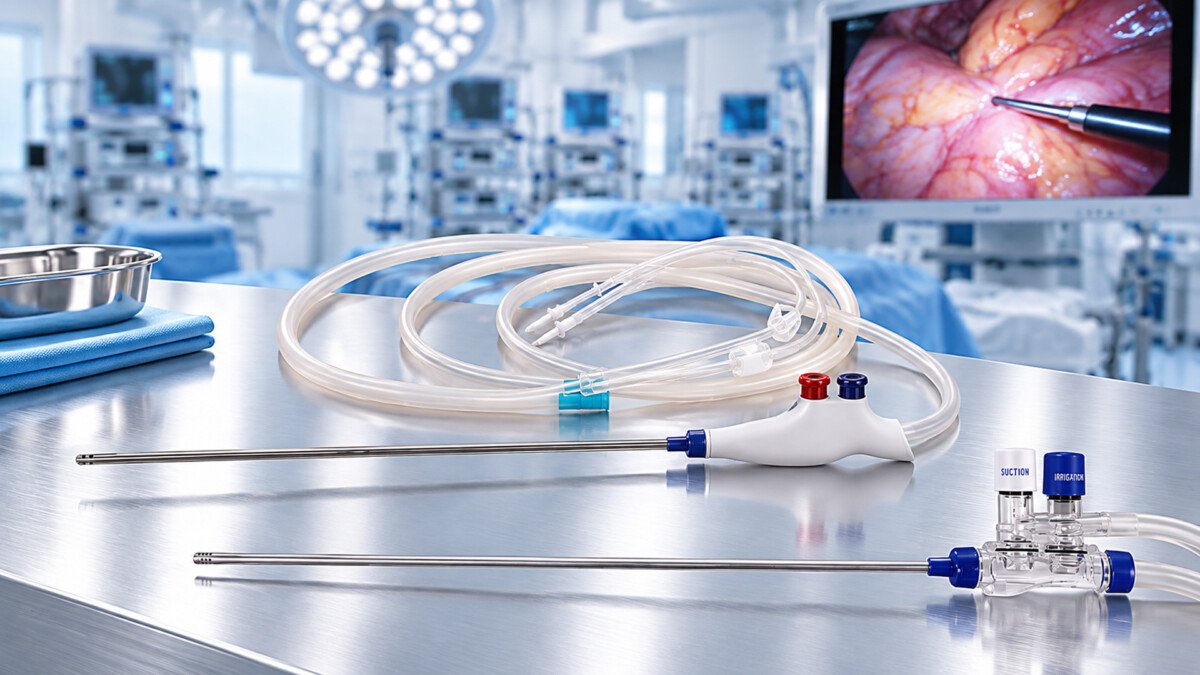
Seemann’s current website presents a sterile single-use suction/irrigation system specified at 5 x 330 mm with two trumpet valves. This demonstrates why professional quotations should identify the dimensions and control arrangement rather than state only “suction irrigation system”.
Buyers should request the latest product data for the precise model under consideration before making a purchasing decision.
Seemann procurement insight: Working length, shaft diameter and valve arrangement should appear directly in the purchasing description. These details allow a sample, quotation and repeat order to remain tied to the same suction-irrigation configuration.
Working Length and Diameter
Laparoscopic instruments operate through defined access systems, making shaft dimensions an important purchasing consideration.
The buyer should establish:
- required instrument diameter;
- required working length;
- access-system constraints;
- existing product dimensions where replacing another device; and
- whether multiple dimensional variants are required.
These measurements should come from current technical information or the purchaser’s controlled requirement.
Valve and Control Arrangement
The control layout affects the exact configuration being supplied.
A distributor should record whether the proposed product uses:
- a particular valve arrangement;
- separate suction and irrigation controls;
- a defined tubing layout; and
- specific connections supplied with the instrument.
Two products may perform the same broad function while differing materially in their controls and connections.
Tubing and Connection Information
Before approving a product, buyers should understand what is included in the supplied sterile unit and which elements belong to the wider theatre setup.
Useful questions include:
- Which tubing is supplied with the instrument?
- Which connections are integrated?
- Does another component need to be sourced separately?
- What information identifies the exact configuration?
- Does the evaluation sample match the proposed production item?
Suction Irrigation Within the Wider MIS Range
A hospital or distributor sourcing suction-irrigation products may also require products for other stages of a minimally invasive procedure.
Related Seemann categories include:
- single-use MIS instruments;
- bipolar dissection and grasping instruments;
- monopolar MIS instruments;
- monopolar electrodes;
- other HF instrument categories; and
- related laparoscopic products.
Connected sourcing can make distributor portfolio planning more coherent, provided each item keeps its own reference and specification.
Sterile Presentation and Inventory Planning
Single-use products are managed differently from reusable instrument inventory.
Distributors and hospitals may need to consider:
- unit packaging;
- sterile product identification;
- pack quantity;
- shelf-life information;
- storage requirements;
- monthly or quarterly consumption;
- safety-stock level; and
- repeat-order lead planning.
The quantities used for evaluation should be kept separate from anticipated routine consumption.
Samples Should Match the Quoted Reference
A sample should allow the purchaser to verify the actual configuration intended for commercial supply.
Review:
- diameter;
- working length;
- control/valve arrangement;
- tubing;
- connections;
- packaging;
- product reference; and
- supporting documentation.
If a later production order changes any of these characteristics, the difference should be identified before approval.
Sourcing for Belgium, Spain and Ireland
Suction-irrigation products can form part of broader disposable laparoscopic instrument programmes supplied to hospitals and specialist surgical centres in Belgium, Spain and Ireland.
Belgian distributors may combine this category with laparoscopic and electrosurgical instruments. Spanish buyers may include suction irrigation within a wider instrumental laparoscópico desechable range. Irish healthcare suppliers can use the category alongside single-use MIS instruments and other laparoscopic products where there is defined hospital demand.
For each destination, economic operators should confirm the applicable product and registration requirements associated with their own role before commercial distribution.
What to Include in a Suction-Irrigation RFQ
- required diameter;
- working length;
- valve or control configuration;
- tubing requirements;
- connection information;
- existing product reference;
- sample quantity;
- forecast commercial quantity;
- packaging requirements;
- destination in Belgium, Spain or Ireland; and
- documentation required for supplier approval.
Frequently Asked Questions
Does Seemann Technologies offer single-use suction-irrigation instruments?
Yes. Seemann lists suction/irrigation instruments within its single-use MIS portfolio.
What suction-irrigation configuration is shown on Seemann’s current website?
The current website presents a sterile single-use suction/irrigation system specified as 5 x 330 mm with two trumpet valves.
What should buyers compare before ordering?
Compare working length, diameter, valve arrangement, tubing, connections, sterile packaging and the exact manufacturer reference.
Are suction-irrigation instruments part of a laparoscopic product range?
Yes. They can be sourced alongside laparoscopic electrodes, bipolar and monopolar MIS instruments and other minimally invasive products.
Why should a sample be linked to a product reference?
It helps ensure that the commercial order corresponds to the configuration that the buyer actually evaluated.
Can distributors request multiple laparoscopic categories in one quotation?
Yes. Each product should be listed separately with its dimensions, reference and quantity.
Request Suction-Irrigation Product Information
Hospitals and distributors can review Seemann Technologies’ single-use MIS portfolio and complete surgical product range. For samples, specifications or quotation requirements in Belgium, Spain or Ireland, contact Seemann Technologies.