
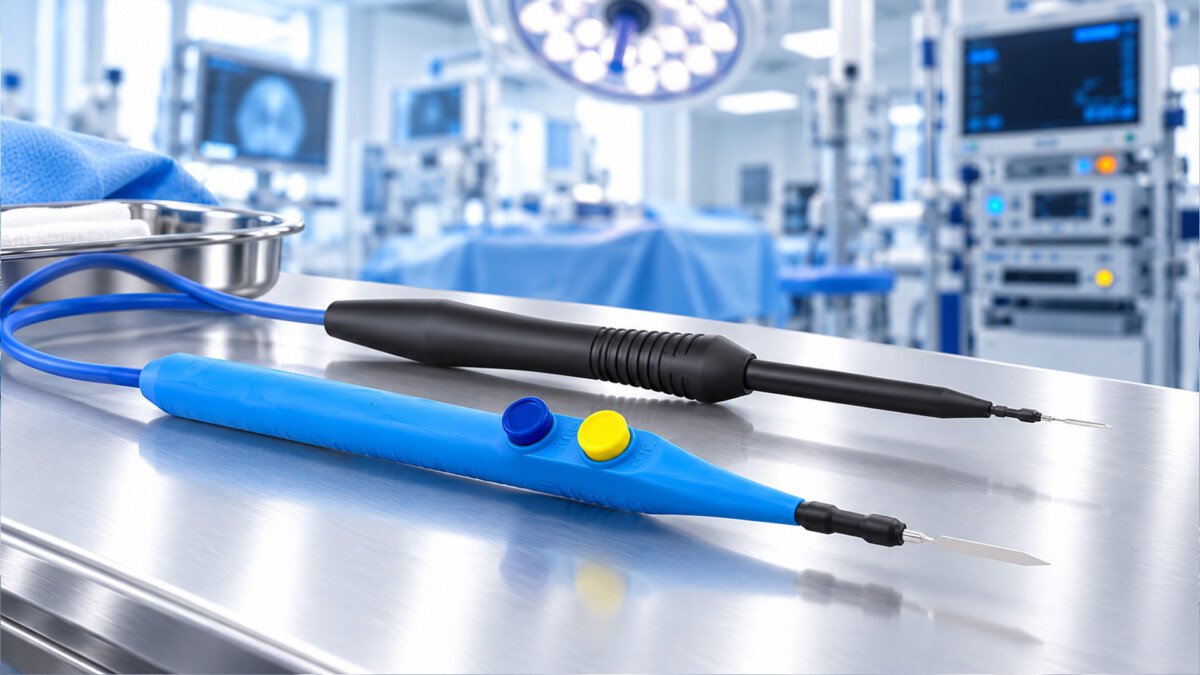
 A practical specification guide for Belgian hospitals, distributors and specialist surgical suppliers
“Cautery pencil” is a familiar purchasing term, but it can conceal several decisions that matter when a hospital or distributor requests a quotation. The handle, control arrangement, active electrode, cable and equipment-side connector all need to be identified before a product can be evaluated as a complete electrosurgical configuration.
Buyers sourcing a cautery pencil in Belgium should specify the required HF handle, control arrangement, electrode, cable and electrosurgical equipment connection. Seemann Technologies uses the verified product terminology HF handles with cables and electrodes; availability and compatibility should be confirmed for the exact reference rather than assumed from the general term “cautery pencil”.
Cautery pencil and HF handle: understanding the terminology
Professional buyers may encounter “cautery pencil”, “electrosurgical pencil”, “diathermy pencil”, “HF handle” and “cautery handpiece” in catalogues and tender documents. These expressions can describe closely related products, but they are not always used consistently between manufacturers, distributors and hospitals.
Seemann’s verified product terminology is HF handles with cables and electrodes, listed within its single-use HF instrument portfolio. Using the manufacturer’s wording in a quotation helps preserve product identity. A buyer can still mention “cautery pencil” as the familiar market term, provided the technical description states what is actually required.
The word “cautery” also has a broader history than modern HF electrosurgery. Procurement records should therefore use the exact product description and manufacturer reference, not the informal term alone.
Five elements define a complete HF-handle requirement
- Handle and control arrangement
The first question is how the connected electrosurgical system is intended to be activated. A purchasing request may refer to hand control or foot control, but those terms should not be converted into a Seemann reference without checking the current catalogue and product documentation. The required arrangement must also match the hospital’s approved equipment setup.
- Active electrode
An HF handle and its electrode should be treated as connected components, even where they are ordered separately. Buyers should record the electrode form, shaft diameter, working or total length where applicable, and the connection at the handle. Seemann’s published single-use monopolar electrode range includes short and long 2.4 mm and 4 mm shaft options, arthroscopic electrodes, a tungsten electrode and conisation electrodes.
- Cable
The cable description should cover whether it is permanently attached or detachable, its length, and both connection ends. “Standard cable” is not an adequate specification because connector conventions vary between equipment manufacturers and product families.
- Equipment-side connector
The exact electrosurgical generator or HF equipment manufacturer, model and socket should be recorded. Similar-looking plugs are not evidence of documented compatibility. A clear photograph can support an enquiry, but it does not replace a verified product reference or compatibility statement.
- Packaging and supply format
The buyer should confirm whether the required reference is single-use or reusable, how it is packaged, whether it is supplied sterile, and what is included in the unit of sale. These details must be taken from the current specification for the exact item rather than extended from another product in the same family.
HF handle selection at a glance
| Selection point | Information to provide | Why it matters |
| Control | Required hand- or foot-control arrangement | Defines how activation is managed within the approved system |
| Electrode | Form, shaft, length and handle connection | Prevents a general handle request from becoming an incomplete order |
| Cable | Attached or detachable, length and connector details | Establishes the physical connection route |
| HF equipment | Manufacturer, model and socket reference | Supports reference-level compatibility review |
| Supply format | Single-use or reusable, sterile status and packaging | Supports item creation, storage and hospital workflow |
Hand control and foot control are system questions
A hand-control request usually indicates that activation controls are expected on the handle. A foot-control request usually means activation is managed through the connected equipment and footswitch. Those descriptions are useful starting points, but they do not confirm that a particular handle, cable or electrode is available or approved for an existing system.
Belgian buyers should send the current handle reference, equipment model and preferred control method together. If the requirement originates from a hospital tender, the distributor should check that the control wording describes the required function without unintentionally excluding an acceptable configuration or implying compatibility that has not been documented.
Seemann procurement insight: The fastest route to a useful compatibility answer is a complete connection record: current HF equipment model, socket, cable ends, handle reference and required electrode.
Selecting the electrode with the handle
The handle should not be assessed in isolation. A hospital may require a particular electrode form or shaft profile, and the chosen electrode must connect correctly to the handle while remaining within the documented intended configuration.
Useful enquiry information includes:
- the current electrode reference, where an existing product is being reviewed;
- electrode form and dimensions required by the approved specification;
- shaft diameter and relevant length;
- connection between the electrode and handle;
- whether a complete handle-and-electrode arrangement is required; and
- the associated HF equipment and cable details.
Seemann’s complete product overview helps buyers place HF handles alongside bipolar forceps, monopolar electrodes, cables and MIS instruments. It should be used to identify the appropriate category before reference-level documentation is requested.
Single-use and reusable procurement routes
Single-use and reusable HF products involve different purchasing and operational considerations. A single-use item may simplify reference control and remove reprocessing between uses, while a reusable item requires an approved cleaning, inspection, maintenance and sterilisation process. The correct choice depends on the product, the healthcare organisation and its established procedures.
Seemann publishes both single-use HF instruments and reusable HF instruments. Buyers should not assume that every handle, cable or electrode is offered in both formats. Sterility, reuse status, packaging and care instructions must be verified for each shortlisted reference.
What Belgian distributors should confirm
A distributor is responsible for more than passing a hospital description to the supplier. It should be able to preserve reference information, provide the relevant documents, maintain traceability and communicate product or safety information through the supply chain where applicable.
Current FAMHP medical-device guidance states that Belgian distributors, or distributors operating on Belgian territory, must register their activity through the FAMHP web portal. Importers and organisations performing certain relabelling or repackaging activities may have different obligations. Buyers should confirm the requirements that apply to their role and the particular device; this information is not legal advice.
Where French- or Dutch-language information is needed, the required labelling and instructions should be checked for the specific device, intended user and Belgian supply route. A distributor should not rely on a translated sales description as a substitute for approved product information.
Documentation for hospital and distributor review
The document set will depend on the product and the buyer’s regulatory role. A professional enquiry may request the current product specification, label and packaging information, instructions for use where applicable, EU Declaration of Conformity, relevant certificate information and UDI data where applicable.
Seemann’s quality information and existing Belgium regulatory overview provide general company context. Approval should still be based on the documentation supplied for the exact handle, electrode or cable under consideration.
Building a clear quotation request
Quotations are easier to compare when every supplier receives the same technical and commercial information. Separate mandatory attributes from preferences and ask the supplier to identify any departure from the requirement.
- State whether the request concerns an HF handle, complete pencil assembly, electrode or cable.
- Provide the current product reference or approved specification.
- Describe the required control arrangement.
- Identify the electrode form, shaft and connection.
- Give the cable length and both connector details.
- Provide the HF equipment manufacturer, model and socket.
- List required documentation, sterile status and packaging information.
- Include sample quantity, annual estimate and Belgian delivery destination.
Samples and product evaluation
A sample request should name the exact reference and the purpose of the evaluation. Record who will review the product, which equipment will be used for the compatibility assessment, and what documentation must accompany the sample. Sample availability and commercial conditions should be confirmed directly.
If the evaluated reference changes, repeat the necessary review. Approval of one electrode or connector should not be transferred to another merely because its general product name is similar.
Planning for repeat supply
Distributors should agree how the approved item will be represented in their own catalogue and the customer’s purchasing system. The manufacturer reference, product description, unit of sale and packaging hierarchy should remain consistent from quotation to repeat order.
Forecasts are more useful when they separate initial evaluation quantities from expected routine demand. Lead time and availability should be confirmed with each commercial discussion rather than treated as permanent guarantees.
Frequently Asked Questions
Does Seemann call the product a cautery pencil?
Seemann’s verified public terminology is “HF handles with cables and electrodes”. “Cautery pencil” may be used as a familiar buying term, but the quotation should identify the actual handle, electrode and cable configuration.
Are hand-control and foot-control HF handles interchangeable?
No interchangeability should be assumed. The control method, handle, cable, equipment model and documented compatibility must be evaluated as one system.
What equipment information should a Belgian buyer provide?
Provide the manufacturer, full model number, socket reference and, where helpful, clear photographs of the existing equipment and connectors.
Can the same HF handle accept every electrode?
Not necessarily. Electrode fit and documented compatibility depend on the handle connection and the approved product configuration.
What documents may a distributor request?
Depending on the product and commercial role, the review may include the specification, label, packaging details, instructions for use, Declaration of Conformity, certificate information and UDI details where applicable.
Can samples be requested for a Belgian hospital evaluation?
Sample availability should be confirmed with Seemann. Include the exact configuration, equipment reference, requested quantity, evaluation purpose and delivery destination.
Does Seemann manufacture electrosurgical generators?
The verified public range supports HF instruments and connected accessories. Buyers should not interpret this product category as a claim that Seemann manufactures electrosurgical generators.
Discuss Your Product Requirements
Send Seemann Technologies the current handle or electrode reference, required control arrangement, cable information, HF equipment model, documentation needs, sample quantity and expected demand. The team can then discuss the most relevant verified HF-handle and electrode options.
Request HF handle information or discuss a Belgian distribution requirement.