
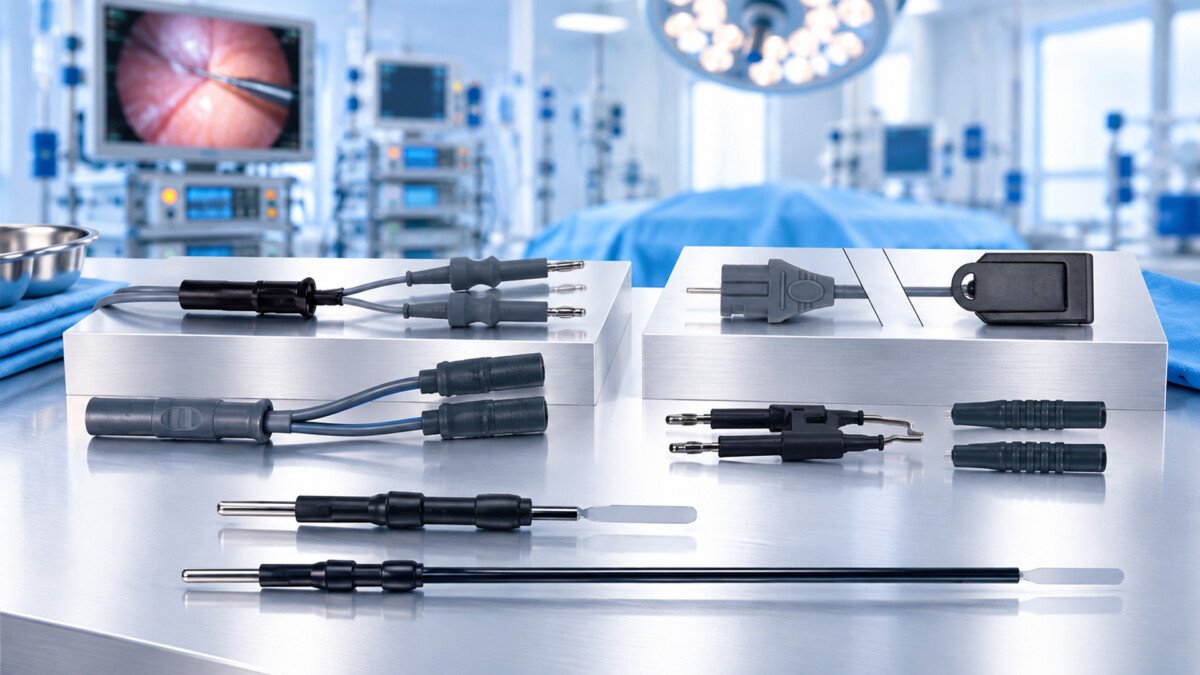
 Identify every physical and electrical interface before approving an electrode reference
Electrode compatibility is often reduced to the connector at the HF equipment, yet the product must fit through a complete chain. Electrode form, shaft diameter, shaft length, handle interface, cable and equipment-side plug all contribute to correct identification. A careful buyer records each attribute instead of relying on a general request for a compatible electrode.
An electrode shaft should be evaluated together with the electrode form, relevant length, handle or cable interface and connected HF equipment. Seemann Technologies publishes 2.4 mm and 4 mm shaft groups across several single-use monopolar electrode families, as well as cable-connected bipolar ENT electrodes with different equipment-side connectors.
What the electrode shaft tells a buyer
The shaft is a physical part of the electrode and may help define diameter, reach, insulation and connection. It does not identify the working electrode form by itself. Two products can share a shaft category while differing at the distal end or in their intended product group.
Seemann’s monopolar electrode range includes short and long 2.4 mm and 4 mm groups, arthroscopic products in the same two shaft categories, a tungsten electrode with an insulated 4 mm shaft and conisation groups with 2.4 mm and 4 mm shafts.
Shaft diameter and shaft length are different fields
Diameter describes the width of the shaft, while length describes reach or total product dimensions depending on the manufacturer specification. A catalogue entry should not compress them into one vague phrase such as “long 4 mm electrode”.
Record the numerical diameter, the relevant working or total length and the source document. If the manufacturer uses short and long category names, retain those as navigation terms while keeping the actual dimensions available for comparison.
Electrode form completes the physical specification
Needle, knife, ball, loop and hook are examples of electrode-form terminology used across electrosurgical catalogues. The exact Seemann product name should be used for the selected reference. An electrode’s form should never be inferred from shaft size alone.
For specialised products, include the product group as well. An arthroscopic needle electrode and a laparoscopic hook electrode may both be monopolar, but their dimensions and connected requirements should remain separate.
Four connection arrangements buyers may encounter
Electrode connected to an HF handle
The electrode-to-handle interface must match the handle specification. The buyer should then continue through the handle, cable and equipment-side connector. Seemann identifies HF handles with cables and electrodes within its published technology range.
Bipolar electrode supplied with cable
Seemann publishes sterile bipolar electrodes with a 5 m cable for ENT. The current selection includes different connector arrangements, so the full product reference and HF equipment model are required.
Forceps connected through a separate bipolar cable
This arrangement concerns bipolar forceps rather than an electrode shaft, but buyers often manage both within the same electrosurgical catalogue. Seemann’s bipolar forceps cable range includes 5 m products with different connector descriptions.
Long-shaft minimally invasive electrode
For laparoscopic electrodes, the shaft profile and working length form a central part of product identification. The single-use MIS instrument information confirms monopolar electrodes for laparoscopy within Seemann’s range.
Compatibility matrix
| Interface | Information to record | What not to assume |
| Electrode to handle | Shaft/interface dimensions and approved handle reference | That a common shaft diameter fits every handle |
| Handle to cable | Permanent or detachable arrangement and cable reference | That all handles use the same cable |
| Cable to HF equipment | Plug geometry, connector name and equipment model | That a similar-looking socket proves compatibility |
| Cable-connected electrode | Complete electrode, cable and connector reference | That cable length identifies the correct product |
Connector names are useful but not sufficient
The verified Seemann ENT bipolar electrode category includes connector descriptions for 2-pin international, ERBE ICC/ACC and Martin arrangements. Its separate bipolar cable information identifies further connector families used in forceps supply.
These names help narrow a search, but the final decision should use the exact product and equipment references. A connector can look familiar while differing in dimensions, orientation or documented use.
Seemann procurement insight: Photograph both ends of a current cable beside the readable reference labels, then include the complete equipment model and instrument reference in the same enquiry.
What to photograph for a compatibility enquiry
Clear images can help resolve incomplete product records. Useful photographs include:
- the complete current electrode or instrument;
- a close view of the electrode or instrument interface;
- both ends of any separate cable;
- the relevant HF equipment socket;
- manufacturer labels and readable product markings; and
- a scale reference where a dimension is uncertain.
Photographs support identification but do not establish compatibility on their own. Current manufacturer documentation should support the proposed combination.
Buyer checklist for electrode and connector compatibility
- Identify the electrode category. Record open-surgery, ENT, arthroscopic or laparoscopic.
- Confirm modality. State monopolar or bipolar.
- Name the electrode form. Use the current manufacturer description.
- Record shaft dimensions. Include diameter and relevant length.
- Identify the handle. Provide the reference and electrode interface where applicable.
- Record the cable. Include length, attachment and both connector ends.
- Provide the HF equipment model. Include a socket image when useful.
- Request documented confirmation. State which specifications or compatibility evidence the organisation requires.
Managing product data for repeat orders
Store the electrode, handle and cable as separate linked references unless the manufacturer supplies them as one defined product. This makes it easier to identify which component has changed when a replacement is requested.
Record the source and date of compatibility information. If the installed equipment, electrode or connector changes, reopen the review rather than relying on an older item note.
Documentation and packaging
Professional buyers may need product specifications, label details, instructions for use where applicable, packaging information and current conformity documentation. Seemann’s quality information provides supplier context, while exact product evidence should be requested during the evaluation.
Single-use status, sterile presentation, shelf life, storage conditions and order configuration should be confirmed for the individual reference. These attributes should not be applied automatically across an entire electrode family.
Build a compatibility record that another buyer can understand
A useful compatibility record should explain the full connection without depending on one employee’s memory. It can include:
- HF equipment manufacturer, model and socket;
- equipment-side connector name and image;
- cable manufacturer and reference;
- handle or instrument-side interface;
- electrode manufacturer reference, form and shaft;
- the source and date of compatibility information; and
- the customer or hospital approval linked to the combination.
This record supports repeat orders, customer-service questions and future equipment changes. It also makes it easier to identify which component needs reassessment when a reference is discontinued or revised.
Separate physical fit from documented compatibility
A shaft may fit an opening and a plug may enter a socket without establishing that the complete combination is appropriate. Physical fit is an observation; compatibility is a documented product and equipment relationship.
Buyers should therefore avoid descriptions such as “fits all 4 mm handles” or “universal connector” unless current manufacturer evidence supports that exact statement. Precise, narrower language is more useful than a broad claim that may fail during product review.
Responsibilities within the buying team
Procurement can coordinate the file, but compatibility decisions often involve several functions. Clinical users define the required product configuration, technical teams assess installed equipment and connection information, regulatory or quality teams review documentation, and the supplier confirms the proposed reference.
When these checks are documented in one workflow, a commercial order is less likely to rely on a partial email or an old connector photograph. Any later product or equipment change can be routed back to the relevant reviewer.
Questions to ask when a reference changes
- Has the electrode form, shaft or length changed?
- Has the handle or instrument-side interface changed?
- Is the cable supplied under a new reference?
- Has the equipment-side connector or orientation changed?
- Does the existing compatibility evidence still apply?
- Are updated product, packaging or conformity documents available?
Frequently Asked Questions
Which electrode shaft sizes does Seemann publish?
The verified monopolar electrode selection includes several 2.4 mm and 4 mm shaft categories.
Does the shaft diameter identify the electrode?
No. Buyers also need the product group, electrode form, length, interface and full reference.
Are ENT bipolar electrodes supplied with cable?
Seemann publishes sterile bipolar ENT electrodes with a 5 m cable in different connector arrangements.
Can connector compatibility be confirmed from a photograph?
A photograph can support identification, but current product and equipment documentation should confirm the exact combination.
What is the difference between an electrode cable and a bipolar forceps cable?
They support different connected products. Each cable should retain its exact manufacturer name, instrument interface and equipment-side connector information.
What should a distributor store in its product database?
Store the full reference, modality, product group, electrode form, shaft, length, handle or cable arrangement, connector and compatibility evidence date.
Where can buyers request a compatibility review?
Use the Seemann Technologies contact form and provide the complete connected-system information.
Discuss Your Product Requirements
Send Seemann Technologies the current electrode, handle and cable references, shaft dimensions, connector photographs, complete HF equipment model, destination and expected quantity. The team can then focus on relevant product information and documented connection options.