
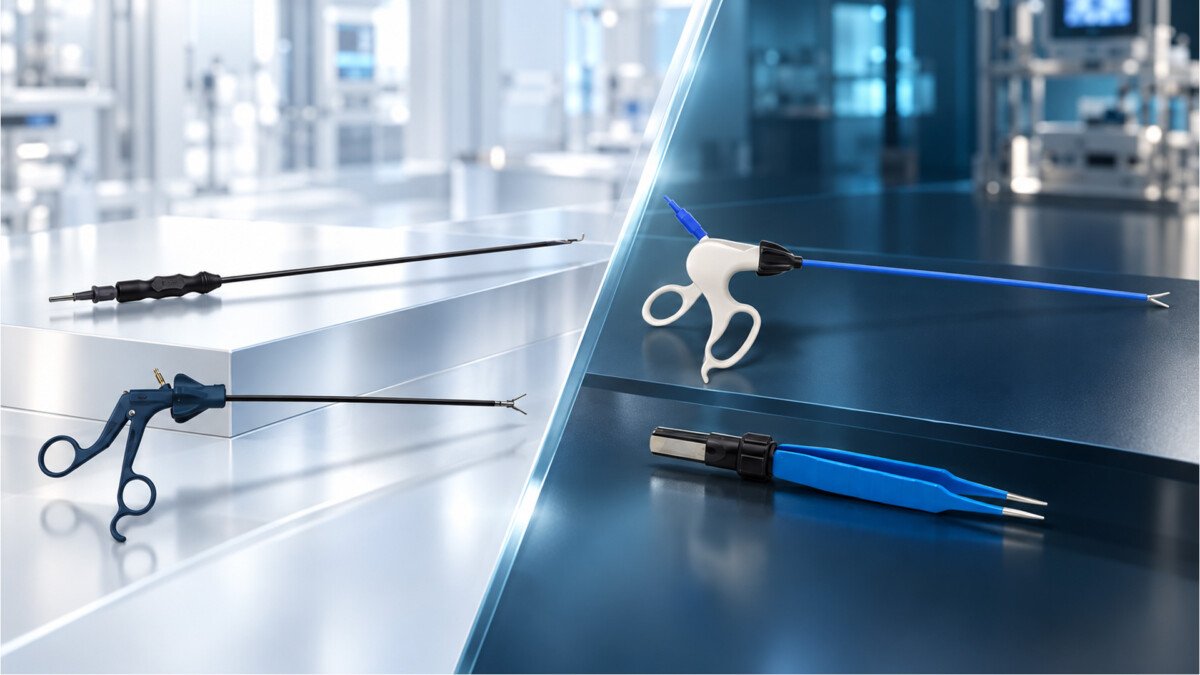
 ⚡ Monopolar and bipolar instruments both belong within electrosurgery, but they should never be treated as interchangeable product categories during procurement.
Understanding the difference between Monopolar vs Bipolar Instruments is important for medical device distributors, hospital procurement teams and healthcare buyers reviewing electrosurgical products.
Both product families are used within high-frequency surgery, but they differ in their instrument configuration, electrical pathway and the connected accessories that may be required.
From a purchasing perspective, this means a buyer should identify whether the requirement is monopolar or bipolar before comparing references, cables, electrodes, forceps or HF equipment connections.
Seemann Technologies provides products across both categories, including Bipolar Forceps, Monopolar Electrodes, bipolar forceps cables and related single-use HF instruments.
What Is the Difference Between Monopolar and Bipolar Electrosurgical Instruments?
The central difference relates to how electrical energy moves through the electrosurgical system.
In a monopolar configuration, the active instrument delivers energy at the surgical site as part of a system that includes the appropriate return pathway.
In a bipolar configuration, current is concentrated between two poles located within the bipolar instrument.
For procurement teams, the practical lesson is straightforward:
A monopolar instrument cannot be specified simply as an alternative version of a bipolar instrument.
The product category, connection and associated equipment requirements need to be reviewed separately.
Common Bipolar Instrument Categories
Bipolar product discussions often begin with Bipolar Forceps.
Seemann Technologies currently presents several bipolar forceps configurations within its single-use HF portfolio.
These include:
- Straight bipolar forceps
- Angled-tip configurations
- Bayonet forceps
- Non-stick bipolar forceps
- Bipolar forceps with cable
- Bipolar forceps with irrigation
The buyer therefore needs to move beyond the broad word “bipolar” and identify the exact physical and connection requirements.
Common Monopolar Instrument Categories
Monopolar product groups can include Monopolar Electrodes, HF handles, laparoscopic electrodes and other monopolar surgical instruments.
The published Seemann electrode range includes multiple shaft sizes and product families, including short and long electrodes, arthroscopic electrodes, tungsten electrodes and conisation electrodes.
Important specification fields can include:
- Electrode type
- Tip geometry
- Shaft diameter
- Total or working length
- Handpiece interface
- HF equipment connection
Monopolar vs Bipolar Instruments: Procurement Comparison
| Area | Monopolar Instruments | Bipolar Instruments |
| Common Seemann product types | Monopolar electrodes and related MIS instruments | Bipolar forceps and bipolar MIS instruments |
| Typical working end | Electrode or monopolar instrument configuration | Two-pole forceps or bipolar instrument configuration |
| Key specification | Tip, shaft, length and connection | Pattern, tip, length, surface and cable |
| Connected accessories | May involve HF handle and relevant connection | May involve separate bipolar cable |
| Best procurement starting point | Current product and equipment reference | Current forceps and cable reference |
Why Bipolar Forceps Pattern Matters
Within the bipolar category, instrument pattern can materially change the product specification.
A straight bipolar forceps is not the same product configuration as a bayonet forceps.
Likewise, an angled distal tip should be identified separately where it forms part of the required reference.
Professional buyers should therefore record:
- Pattern
- Instrument length
- Tip specification
- Standard or non-stick requirement
- Cable configuration
Why Monopolar Electrode Shaft Diameter Matters
Within the monopolar category, shaft diameter can become an important identifying feature.
Seemann Technologies currently organises parts of its monopolar electrode portfolio around 2.4 mm and 4 mm shaft categories.
A buyer should therefore include the required shaft dimension whenever it is part of the approved product specification.
This is particularly important when several products use similar working-end shapes.
Bipolar Cables Are Part of the System
A bipolar forceps may require a separate cable depending on the specific reference.
Seemann Technologies provides a dedicated single-use bipolar cable range with several HF equipment-side connector configurations.
For a bipolar enquiry, buyers should establish:
- Whether the cable is integrated
- Whether it is supplied separately
- Instrument-side connection
- HF equipment-side connection
- Current cable reference
Monopolar Handles and Electrodes Should Be Reviewed Together
Monopolar electrode selection may also involve an HF handle or cautery pencil.
The buyer should therefore confirm whether the requested electrode fits the existing handpiece configuration.
Useful information can include:
- Existing HF handle reference
- Electrode shaft/interface
- Control method
- Cable configuration
- Generator information
This reduces the risk of selecting an electrode based only on its distal geometry.
Monopolar vs Bipolar Does Not Mean Better vs Worse
The comparison between Monopolar vs Bipolar Instruments should not be presented as a universal winner-and-loser comparison.
They are different electrosurgical configurations selected according to the documented clinical and equipment requirements of the healthcare organisation.
For a procurement page, the useful question is not:
“Which technology is better?”
It is:
“Which product configuration is specified for the intended system and application?”
Single-Use Electrosurgical Instrument Planning
Seemann Technologies has a strong focus on single-use HF instruments.
Single-use status adds its own procurement considerations, such as reference-specific packaging, sterile presentation, shelf-life information and ordering quantities.
These should be checked alongside the electrical configuration rather than treated as separate afterthoughts.
Questions Buyers Should Ask Before Requesting a Quote
| Question | Why It Matters |
| Is the requirement monopolar or bipolar? | Defines the primary instrument family |
| What product is currently used? | Provides a reference point for comparison |
| What physical configuration is required? | Identifies pattern, tip, shaft and length |
| Is a cable or HF handle required? | Defines connected accessories |
| Which equipment must it connect to? | Supports connector verification |
| Is the product single-use? | Clarifies supply and packaging model |
Related Seemann Technologies Product Categories
Professional buyers comparing monopolar and bipolar products can review:
- Electrosurgical Instruments
- Bipolar Forceps
- Monopolar Electrodes
- Single-Use Bipolar Cables
- Cautery Pencils and HF Handles
Frequently Asked Questions
Are monopolar and bipolar instruments interchangeable?
No. They represent different electrosurgical configurations and should be selected according to the required product and equipment setup.
What is the main bipolar product category offered by Seemann Technologies?
The current HF range includes multiple single-use bipolar forceps configurations along with bipolar cables and additional bipolar MIS instruments.
Which monopolar products are available?
The published range includes multiple monopolar electrode categories and monopolar instruments for minimally invasive surgery.
What information helps suppliers identify the correct product?
The current reference, required configuration, dimensions, cable or handle requirement and HF equipment information provide the strongest starting point.
Discuss Your Monopolar or Bipolar Instrument Requirements
Seemann Technologies provides Electrosurgical Instruments across monopolar and bipolar product categories for professional healthcare buyers and medical device distributors.
Send your current product reference and technical requirements to begin a focused product discussion.