
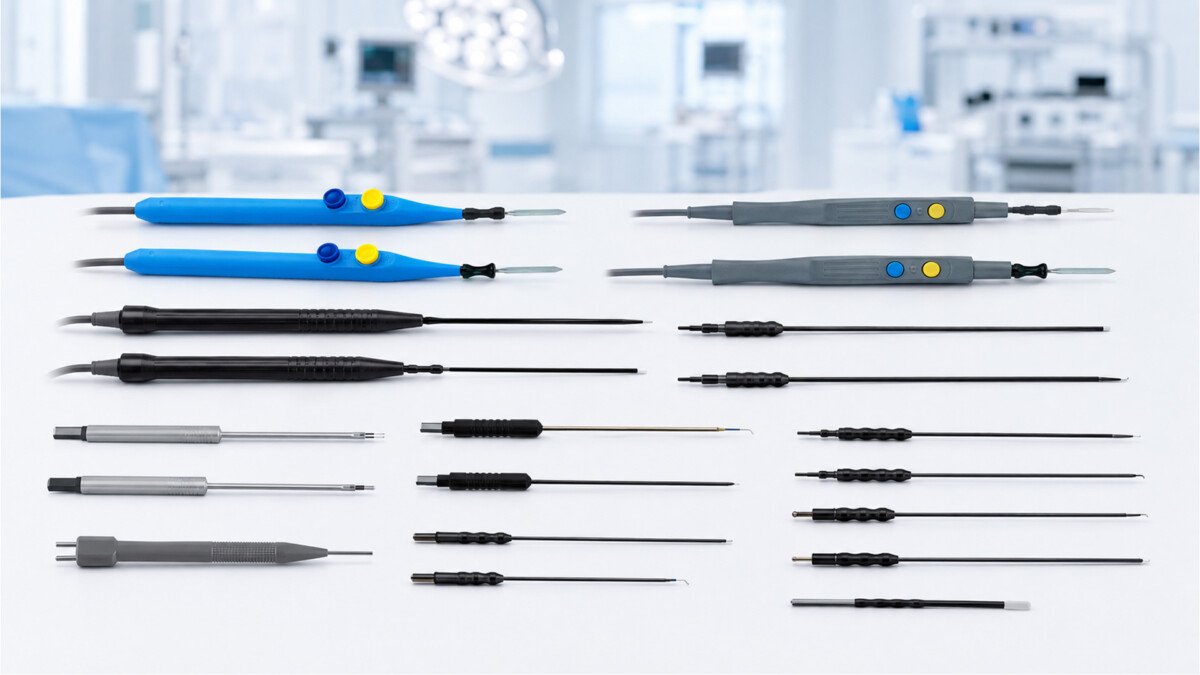
 How professional buyers can turn familiar market terminology into a precise product enquiry
“Cautery pencil” is a familiar purchasing term in many markets, yet manufacturers may classify the same broad product area as an electrosurgical pencil, diathermy pencil or HF handle. The words can help begin a conversation, but they do not identify the required control method, electrode interface, cable or equipment-side connector. Those details determine whether a product is suitable for evaluation.
A cautery pencil or HF handle should be selected by confirming the control arrangement, compatible electrode interface, cable length and HF equipment connector. Seemann Technologies uses the term “HF handles with cables and electrodes” in its published range; availability of a specific hand-control, foot-control or detachable configuration should be confirmed against current product documentation.
Begin with the manufacturer’s product terminology
Market language varies. “Cautery pencil” may be the term used by a hospital’s procurement system, while the supplier’s catalogue may use “HF handle”. Neither wording is wrong in a general conversation, but quotations and product records should use the exact manufacturer designation for the reference being supplied.
Seemann’s single-use HF technology overview identifies HF handles with cables and electrodes among the company’s important product categories. It does not justify assuming that every control style, connector or electrode combination is available. Buyers should ask for the current catalogue entry and specification that corresponds to their requirement.
The four parts of a clear HF handle enquiry
- Control arrangement
Professional buyers commonly distinguish hand-control and foot-control configurations. A hand-control product incorporates switching controls in the handle, while a foot-control arrangement relies on compatible external control through the connected HF system. That general distinction should be verified for the exact product and equipment combination.
Do not infer the control method from the product’s shape. The approved specification, connector arrangement and manufacturer documentation should establish how the handle is intended to be used.
- Electrode interface
The handle and electrode must use a documented interface. Buyers should record the electrode connection, accepted shaft dimensions where specified and whether the requested product is supplied with an electrode or intended for a detachable electrode.
Seemann publishes a broad range of single-use monopolar electrodes, including short and long groups with different shaft diameters and specialised arthroscopic, tungsten and conisation products. The presence of these categories does not make every electrode compatible with every handle.
- Cable
Cable length, flexibility and attachment to the handle are practical parts of the specification. The buyer should clarify whether the cable is permanently connected, supplied as part of the product or handled through another defined arrangement. Any requested length should be stated numerically.
- Equipment-side connector
The plug at the HF equipment end must match the documented interface of the installed system. Similar-looking connectors should not be treated as interchangeable. The equipment manufacturer and model, existing handle reference and clear connector photographs are useful evidence for a compatibility enquiry.
Hand-control and foot-control: a procurement comparison
| Selection point | Hand-control requirement | Foot-control requirement |
| Control input | Switching controls are associated with the handle configuration | Activation depends on the documented external control arrangement |
| Information to provide | Button/control specification, cable and connector details | Handle type, equipment reference and compatible control setup |
| Electrode questions | Supplied or detachable electrode, shaft/interface and approved combinations | Supplied or detachable electrode, shaft/interface and approved combinations |
| Compatibility evidence | Exact handle and HF equipment documentation | Exact handle, HF equipment and control documentation |
The comparison describes common purchasing distinctions, not a statement that every listed option forms part of Seemann’s current catalogue. Reference availability should be confirmed directly.
Detachable and supplied-electrode arrangements
A detachable arrangement allows the electrode and handle to be specified separately. A supplied-electrode arrangement may combine components under one product reference. The buyer should establish which model applies because it affects item setup, replacement planning, packaging and the information required for repeat ordering.
Where electrodes are selected separately, the request should include electrode form, shaft diameter, length and the required handle interface. A term such as “standard electrode” is not specific enough for compatibility confirmation.
Compatibility is a chain, not a single plug
An HF handle sits between the electrode and the electrosurgical equipment. All interfaces in that chain need to be understood:
- the required electrode form and dimensions;
- the electrode-to-handle interface;
- the handle’s control arrangement;
- the cable type and length;
- the equipment-side connector; and
- the exact HF equipment manufacturer and model.
Visual similarity at one point does not confirm the complete combination. Product information should be checked against the current equipment and instrument documentation before purchase.
Seemann procurement insight: A useful compatibility request includes one photograph of the complete current handle, one close image of its connector and the full HF equipment model reference.
Single-use or reusable supply
The supply format affects more than the instrument description. Hospitals may compare sterile presentation, storage, stock control and reprocessing requirements. Distributors may need to record unit packaging, case configuration, shelf life and repeat-order demand.
Seemann’s product overview separates single-use HF products from reusable HF instruments. The intended-use status of an individual handle or connected product should be taken from its current product information, not inferred from the surrounding category.
Buyer checklist for an accurate product request
- Terminology and exact current product reference
- Hand-control, foot-control or other documented arrangement
- Supplied or detachable electrode requirement
- Electrode form, shaft and length
- Cable attachment and required length
- Equipment-side connector
- HF equipment manufacturer and model
- Single-use or reusable status
- Sterile and packaging information for the exact reference
- Required documentation, sample quantity and forecast demand
Documentation and supplier review
A procurement or distributor review may require the product specification, label information, instructions for use where applicable, packaging details and current conformity evidence. Seemann’s quality overview gives background on the company’s quality approach, while individual product documents should be requested for the shortlisted reference.
If the request concerns a replacement for an established product, the buyer should identify which attributes are mandatory. A supplier can then assess the requirement against documented product information rather than treating a broad product name as proof of equivalence.
Common causes of an incomplete HF handle enquiry
Many delays come from small omissions rather than unusual technical problems. The following descriptions sound understandable but leave essential questions unanswered:
- “Standard cautery pencil” does not identify control method, electrode arrangement or connector.
- “Compatible with our generator” does not provide the equipment manufacturer and model.
- “Long cable” needs a numerical length.
- “Universal electrode” does not establish the handle interface or approved combination.
- “Same as the current product” is useful only when the current reference and specification are supplied.
Replacing each loose phrase with one verifiable detail makes the request easier to assess and gives procurement a stronger audit trail.
From initial enquiry to repeat supply
- Document the current handle, electrode and HF equipment references.
- Confirm the control, cable and connector arrangement.
- Request the current product specification and relevant supporting documents.
- Arrange any sample review through the organisation’s normal process.
- Confirm packaging, quantity, availability and delivery terms in the quotation.
- Store the approved reference and connection information for repeat orders.
This sequence keeps the commercial conversation practical while leaving clinical use and equipment operation to the relevant manufacturer instructions and trained professionals.
For repeat orders, the approved manufacturer reference should take priority over informal local names. If a hospital continues to use “cautery pencil” internally, the distributor can retain that familiar description as a searchable synonym while keeping Seemann’s exact HF handle name in the official item record.
Frequently Asked Questions
Is a cautery pencil the same as an HF handle?
The terms are often used for the same broad purchasing area, but the exact manufacturer designation and specification should be used for quotations and orders.
Does Seemann call its products cautery pencils?
The verified Seemann technology information uses “HF handles with cables and electrodes”. A specific product name and configuration should be confirmed from the current catalogue.
Does Seemann offer hand-control and foot-control products?
The exact availability of these configurations was not established from the live category information reviewed for this guide. Buyers should request current product documentation before assigning either description to a Seemann reference.
Can any monopolar electrode be used with any HF handle?
No. The electrode interface, shaft requirements, handle specification and equipment compatibility must be confirmed for the proposed combination.
What information is needed for a connector check?
Provide the HF equipment manufacturer and model, current handle reference, connector photographs, cable details and any existing electrode reference.
Should a buyer request a sample before changing products?
The organisation’s normal approval process should determine whether a sample evaluation is needed. Sample availability and conditions should be discussed with the supplier.
Where can hospitals and distributors request product information?
Use the Seemann Technologies contact form to request the current catalogue, specifications, sample information or quotation support.
Discuss Your Product Requirements
Send the current handle or pencil reference, required control arrangement, electrode details, cable length, connector information, HF equipment model, destination market and estimated volume. Seemann Technologies can then determine which current product information is relevant to the enquiry.
Discuss an HF handle, electrode or compatibility requirement.