
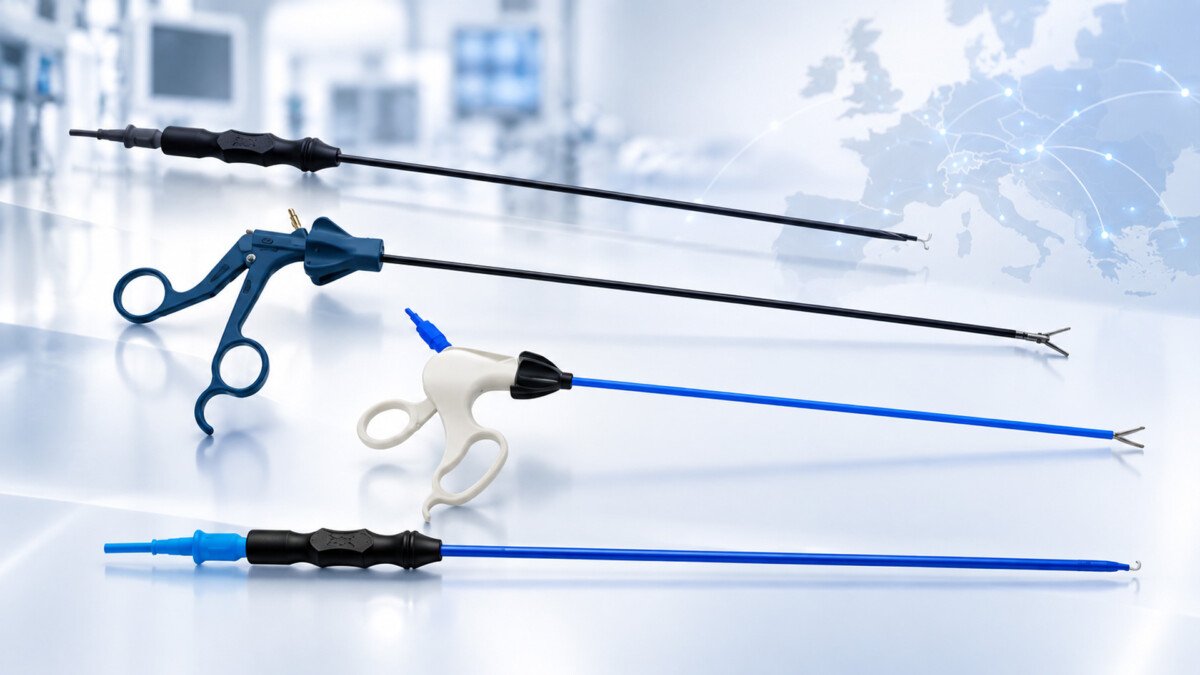
 How to build a commercially coherent MIS range around access, energy, suction and procedure-specific requirements
Laparoscopic instrument procurement involves several connected product families rather than one general category. Medical distributors serving hospitals need to distinguish access products, electrosurgical instruments, suction-irrigation systems and other MIS products by function, working length, shaft dimensions, compatibility, sterile presentation and product reference.
A strong laparoscopic procurement programme groups products by their role in minimally invasive surgery and maintains a controlled specification for every instrument. Distributors should evaluate access products, HF instruments, electrodes, suction-irrigation systems and related MIS categories together while confirming dimensions, connections, packaging and documentation separately.
Why Laparoscopic Procurement Needs a Portfolio Approach
A minimally invasive procedure can involve several different product requirements, each serving a specific purpose.
For distributors, this means a useful range should not be one long list of “laparoscopic instruments”. It should be organised into understandable purchasing categories.
Core Laparoscopic Product Groups
| Product family | Main procurement focus |
| Access products | Diameter, length, intended access system and packaging |
| Bipolar MIS instruments | Jaw pattern, shaft, working length and HF connection |
| Monopolar MIS instruments | Working end, shaft, insulation and equipment interface |
| Monopolar laparoscopic electrodes | Electrode geometry, shaft diameter, length and handpiece fit |
| Suction-irrigation instruments | Diameter, length, valve/control arrangement and tubing |
| Procedure-support products | Function, dimensions, packaging and product reference |
Single-Use MIS Instruments
Seemann Technologies’ single-use MIS range includes bipolar dissection and grasping instruments, bipolar scissors, monopolar dissection and grasping instruments, monopolar scissors, laparoscopic monopolar electrodes and suction/irrigation instruments.
This gives distributors several connected categories to evaluate while preserving separate specifications for each product.
Monopolar Electrodes for Laparoscopy
Laparoscopic electrodes should be specified by more than tip shape.
Important details include:
- working-end configuration;
- shaft diameter;
- working length;
- insulation;
- handpiece/interface;
- electrosurgical equipment; and
- sterile product reference.
Seemann’s single-use monopolar electrode portfolio includes multiple shaft families and specialised products.
Bipolar MIS Instruments
Bipolar instruments used for minimally invasive procedures should remain separate from conventional open bipolar forceps in distributor catalogues.
Buyers may need to identify:
- jaw geometry;
- shaft diameter;
- working length;
- handle configuration;
- cable arrangement; and
- compatible HF equipment.
Where an existing hospital reference is being replaced, it should be included in the enquiry.
Suction-Irrigation Products
Suction irrigation is another core MIS category that requires a controlled product description.
Seemann’s website currently presents a 5 x 330 mm sterile single-use suction/irrigation instrument with two trumpet valves.
A distributor comparing alternatives should record:
- diameter;
- working length;
- valve arrangement;
- tubing connections;
- sterile packaging; and
- manufacturer reference.
Seemann procurement insight: A useful laparoscopic catalogue is organised by procedure function and controlled specifications, not by the number of products listed. Buyers should be able to understand immediately whether an item provides access, energy delivery, dissection, suction/irrigation or another defined role.
HF Instruments and Laparoscopic Surgery
Electrosurgery frequently forms part of a laparoscopic product requirement.
Distributors can therefore connect MIS sourcing with Seemann’s wider single-use HF instrument range, including bipolar forceps, monopolar electrodes and cables.
However, products used in open surgery and minimally invasive surgery should retain separate product descriptions where their dimensions and applications differ.
How to Build an Entry-Level Distributor Portfolio
- Review current hospital enquiries and commonly performed procedures.
- Identify the MIS shaft diameters and lengths most frequently requested.
- Select core monopolar and bipolar instruments.
- Add suction-irrigation products where customer demand exists.
- Add required access and procedure-support categories.
- Map electrosurgical products to their relevant cables and equipment.
- Obtain samples and documentation for the initial commercial range.
- Expand specialist SKUs according to actual customer demand.
Single-Use Product Planning
Single-use products should be forecast using anticipated procedure demand.
A distributor may separate inventory into:
- core stock references;
- customer-specific products;
- specialist order-only references;
- sample/evaluation products; and
- new references awaiting approval.
This creates a more controlled inventory than stocking every available instrument variant.
Documentation for Laparoscopic Procurement
European hospitals and distributors may require product information covering:
- intended use;
- dimensions;
- sterile status;
- packaging;
- compatibility;
- instructions for use; and
- applicable conformity information.
Similar-looking products may have different functions, so documentation should remain linked to the exact catalogue reference.
Belgium: Building a Connected Laparoscopic Range
Belgian distributors can combine laparoscopic instruments in Belgium with established electrosurgical categories such as single-use HF instruments, bipolar forceps and monopolar electrodes.
For commercial supply, the distributor should also review applicable FAMHP registration and distribution requirements.
Spain: Disposable Laparoscopic Product Requirements
Spanish hospitals and distributors may source a broad instrumental laparoscópico desechable range covering access, energy and suction-related products.
Technical information should remain precise regardless of whether the commercial material is presented in English or Spanish. Economic operators should also review current AEMPS and RECOPS requirements.
Ireland: High-Intent Laparoscopic Supply
Irish distributors looking for a laparoscopic instruments supplier in Ireland typically need defined product information, reliable references and a clear process for requesting samples and documentation.
Irish economic operators should confirm their HPRA registration obligations based on their role in the device supply chain.
Distributor Procurement Checklist
- Is every product grouped by its actual surgical function?
- Are shaft diameter and working length documented?
- Are monopolar and bipolar products clearly separated?
- Are connection requirements recorded?
- Can the supplier provide samples against exact references?
- Is sterile packaging clearly identified?
- Can related products be quoted together without losing specification detail?
- Are destination-market documents available?
- Can approved references be reordered accurately?
Frequently Asked Questions
Which products belong in a laparoscopic instrument portfolio?
A portfolio may include access products, bipolar and monopolar MIS instruments, laparoscopic electrodes, suction-irrigation products and other procedure-support categories.
Does Seemann manufacture single-use MIS instruments?
Seemann Technologies presents dedicated single-use MIS product families for minimally invasive surgery.
Why should distributors separate open and laparoscopic HF products?
Their shaft lengths, dimensions and access requirements can differ significantly even when they use the same electrical modality.
What should a distributor check for a laparoscopic electrode?
Review working-end geometry, shaft diameter, working length, insulation, interface and compatible equipment.
Why is suction irrigation important to a distributor range?
It is a distinct MIS product category commonly sourced alongside other minimally invasive products and should have its own controlled specification.
Can products be sourced for Belgium, Spain and Ireland from one enquiry?
Commercial requirements can be discussed together, but destination-specific documentation and economic-operator obligations should be reviewed separately.
Discuss a Laparoscopic Product Programme
Medical distributors can explore Seemann Technologies’ single-use MIS instruments, single-use HF products and complete surgical range. To request product references, samples or distributor quotation information, contact Seemann Technologies.