
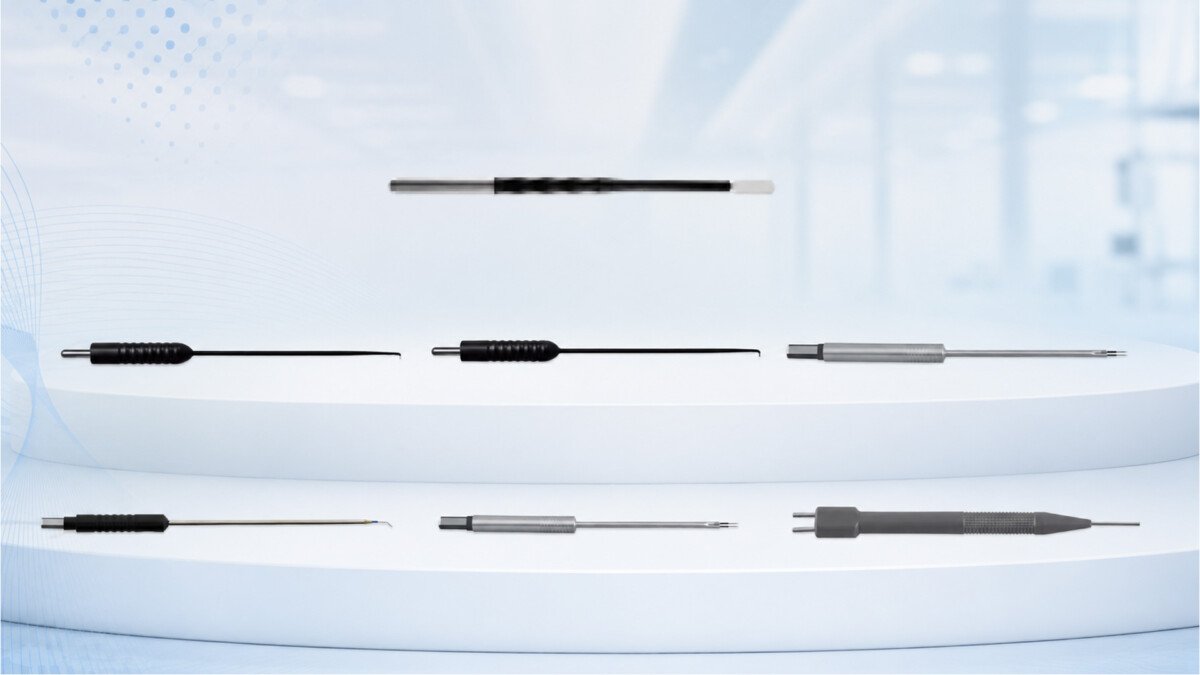
 Match modality, electrode form, shaft and connection to one clearly defined purchasing requirement
ENT, arthroscopic and laparoscopic electrodes belong to specialised product groups, yet they are often reduced to one general request for an electrosurgical electrode. That makes comparison difficult. Each category brings its own questions about monopolar or bipolar technology, electrode geometry, shaft dimensions, cable arrangement and connection to compatible HF equipment.
Electrosurgical electrode selection should begin by identifying the required clinical product category and whether the electrode is monopolar or bipolar. Seemann Technologies publishes bipolar ENT electrodes with a 5 m cable, monopolar arthroscopic electrodes in 2.4 mm and 4 mm shaft groups, and monopolar electrodes for laparoscopy within its single-use MIS range.
Why these electrode categories should remain separate
An electrode’s category is not simply a marketing label. It helps define the physical configuration and the product information that a buyer needs to verify. Combining ENT, arthroscopic and laparoscopic products under one item description can hide differences in modality, shaft, electrode form and connection.
Seemann’s electrode selection presents several distinct product groups. The same category includes monopolar electrode families and a separate bipolar ENT range, so procurement records should preserve the correct modality for every reference.
ENT bipolar electrodes with cable
The verified Seemann range includes sterile ENT Bipolar Electrode products supplied with a 5 m cable. Published connector examples include a 2-pin international connector, an ERBE ICC/ACC connector and a Martin connector. These are separate product arrangements and should not be treated as one universal cable.
An ENT enquiry should identify the exact electrode reference, cable length, equipment-side connector and HF equipment model. If the buyer is replacing an existing electrode, provide the current reference and clear photographs of the instrument and connection point.
Arthroscopic monopolar electrodes
Seemann publishes sterile arthroscopic electrodes in 2.4 mm and 4 mm shaft categories. The current category information includes 90-degree angled needle-electrode configurations with published electrode lengths and diameters. Buyers should use the current product specification for the numerical values associated with the shortlisted reference.
Shaft diameter, electrode form and distal geometry should be stored separately in a product record. A common shaft category does not make two electrode forms interchangeable, and the word “arthroscopic” does not establish connection compatibility.
Laparoscopic monopolar electrodes
Seemann’s single-use MIS instrument range identifies monopolar electrodes for laparoscopy. The company’s published product examples also include a single-use monopolar hook electrode for laparoscopic use.
A laparoscopic electrode request should include the electrode profile, shaft diameter, working length and equipment connection. These dimensions are central to product identification and should not be guessed from an image or a familiar product name.
Comparison of the three product groups
| Product group | Verified Seemann positioning | Key selection information |
| ENT bipolar electrodes | Sterile single-use bipolar electrodes with 5 m cable | Electrode reference, cable plug and HF equipment model |
| Arthroscopic electrodes | Sterile single-use monopolar groups with 2.4 mm and 4 mm shafts | Electrode form, shaft, distal geometry, dimensions and connection |
| Laparoscopic electrodes | Monopolar electrodes within the single-use MIS range | Tip profile, shaft diameter, working length and equipment interface |
Modality is the first technical distinction
ENT products in the verified Seemann selection are identified as bipolar electrodes, while the arthroscopic and laparoscopic groups discussed here are monopolar. Buyers should state the modality at the beginning of an enquiry because it affects the entire connected arrangement.
The terms “forceps” and “electrode” should also remain distinct. An electrode is not a monopolar forceps, and a bipolar ENT electrode should not be catalogued as bipolar forceps merely because it uses bipolar technology.
Electrode form and shaft answer different questions
Electrode form describes the working geometry, while the shaft provides dimensional and connection information. Needle, hook and other electrode descriptions should follow the manufacturer’s current product name. Shaft diameter and working or total length should be recorded numerically.
This distinction helps distributors create useful filters and enables hospitals to compare products against approved specifications. It also reduces the risk of treating two electrodes with the same shaft diameter as equivalent.
Seemann procurement insight: Begin an electrode enquiry with four fields—modality, product group, electrode form and shaft—then add the cable or handle connection and HF equipment model.
Connection requirements by electrode type
Cable-connected bipolar electrodes
For an ENT bipolar electrode supplied with cable, confirm the equipment-side connector and the exact HF equipment model. Connector families may be offered in more than one product variant, so the cable length alone is not enough.
Electrodes used with an HF handle
Where a monopolar electrode connects through an HF handle, the buyer should map the electrode-to-handle interface, handle control arrangement, handle cable and equipment-side plug. Seemann’s HF technology information identifies HF handles with cables and electrodes among its published product families.
Long-shaft MIS products
Laparoscopic electrode enquiries require careful attention to working length and shaft profile. The connected equipment and handle arrangement should be verified for the complete proposed reference, not inferred from another electrode in the same portfolio.
Buyer checklist for specialised electrodes
- State the product group. Identify ENT, arthroscopic or laparoscopic requirements.
- Confirm the modality. Record bipolar or monopolar explicitly.
- Name the electrode form. Use the manufacturer’s current terminology.
- Record shaft dimensions. Include diameter and relevant working or total length.
- Map the connection. Identify any handle, cable and equipment-side connector.
- Provide the HF equipment model. Include manufacturer and complete model reference.
- Request current documentation. Specify the product, packaging and conformity evidence needed.
- Explain the commercial requirement. Include sample quantity, destination and expected demand.
Using an existing reference to improve the comparison
A current product reference gives the supplier a reliable starting point. It allows the buyer and supplier to compare modality, geometry, shaft, length and connection without relying on a loose description. Photographs can support the process, particularly where connector markings are difficult to read.
A proposed alternative should not be presented as equivalent from visual similarity alone. Reference-level specifications and the organisation’s normal clinical and technical approval process should support any product change.
Packaging and documentation
For each shortlisted electrode, request current information on sterile status, unit packaging, outer packaging, shelf life and storage conditions. These details affect hospital item setup, distributor inventory records and repeat ordering.
Buyers may also require specifications, label information, instructions for use where applicable and current conformity documentation. Seemann’s quality overview provides company background, while the exact product evidence should be confirmed during the enquiry.
Building a distributor electrode catalogue
Do not organise specialised electrodes around one general “diathermy” field. A stronger product record separates:
- ENT, arthroscopic or laparoscopic category;
- bipolar or monopolar modality;
- electrode form;
- shaft diameter and relevant length;
- cable inclusion or handle interface;
- equipment-side connector; and
- current manufacturer reference.
That structure supports natural catalogue navigation and makes customer enquiries more precise. The complete Seemann product overview can help distributors place electrodes within the wider single-use and reusable HF portfolio.
Use samples to answer category-specific questions
A sample request should reflect the product group rather than use one general evaluation form for every electrode. For an ENT bipolar electrode, the unresolved question may concern the complete cable and equipment connector. For an arthroscopic product, it may concern the documented shaft and distal geometry. For a laparoscopic electrode, the working length and handle connection may be central to the comparison.
State the exact reference, evaluation objective, sample quantity and evidence required with the product. The organisation should retain the result against the same reference used in any later commercial order.
Common product-data errors to prevent
- dropping “bipolar” from an ENT electrode description;
- recording 2.4 mm and 4 mm shaft groups as one variant;
- using electrode length where the field requires shaft diameter;
- replacing a defined electrode form with the word “standard”;
- omitting the cable connector from a cable-connected product; and
- placing arthroscopic and laparoscopic products in one undifferentiated group.
These are small database errors with practical consequences. Structured fields and the complete manufacturer reference help a distributor preserve accuracy across quotations, translations and repeat orders.
When more than one department reviews the electrode
Clinical stakeholders may define the expected product configuration, technical teams may review the connection, procurement may assess supply terms and regulatory staff may review documentation. A shared comparison record keeps these decisions connected without asking any one department to make assumptions outside its role.
If a proposed product changes after evaluation, the revised reference should return to the appropriate reviewers. A similar name should not be used to carry approval from one electrode to another.
Frequently Asked Questions
Does Seemann offer an ENT Bipolar Electrode?
Yes. The verified selection includes sterile single-use bipolar electrodes with a 5 m cable for ENT in several connector arrangements.
Which arthroscopic electrode shaft sizes are published?
Seemann publishes sterile single-use monopolar arthroscopic electrode groups with 2.4 mm and 4 mm shafts.
Does Seemann publish laparoscopic electrodes?
The single-use MIS information identifies monopolar electrodes for laparoscopy, and published examples include a monopolar hook electrode.
Can an electrode be selected from the procedure category alone?
No. Modality, electrode form, shaft dimensions, length, connection and HF equipment compatibility should also be confirmed.
Are all 5 m ENT electrode cables fitted with the same plug?
No. The published range includes different equipment-side connector arrangements. The exact reference must match the documented equipment requirement.
What should be included in a sample request?
Include the product group, current or shortlisted reference, evaluation objective, sample quantity, equipment information and delivery destination.
Where can buyers request current specifications?
Hospitals and distributors can use the Seemann Technologies contact form to request product information, sample details or a quotation.
Discuss Your Product Requirements
Send Seemann Technologies the electrode group, modality, electrode form, shaft dimensions, connection details, HF equipment model, destination and estimated quantity. Precise information helps the team identify relevant references and supporting documents more efficiently.
Request ENT, arthroscopic or laparoscopic electrode information.