
 Clear terminology and specification-led selection for hospitals, distributors and surgical suppliers
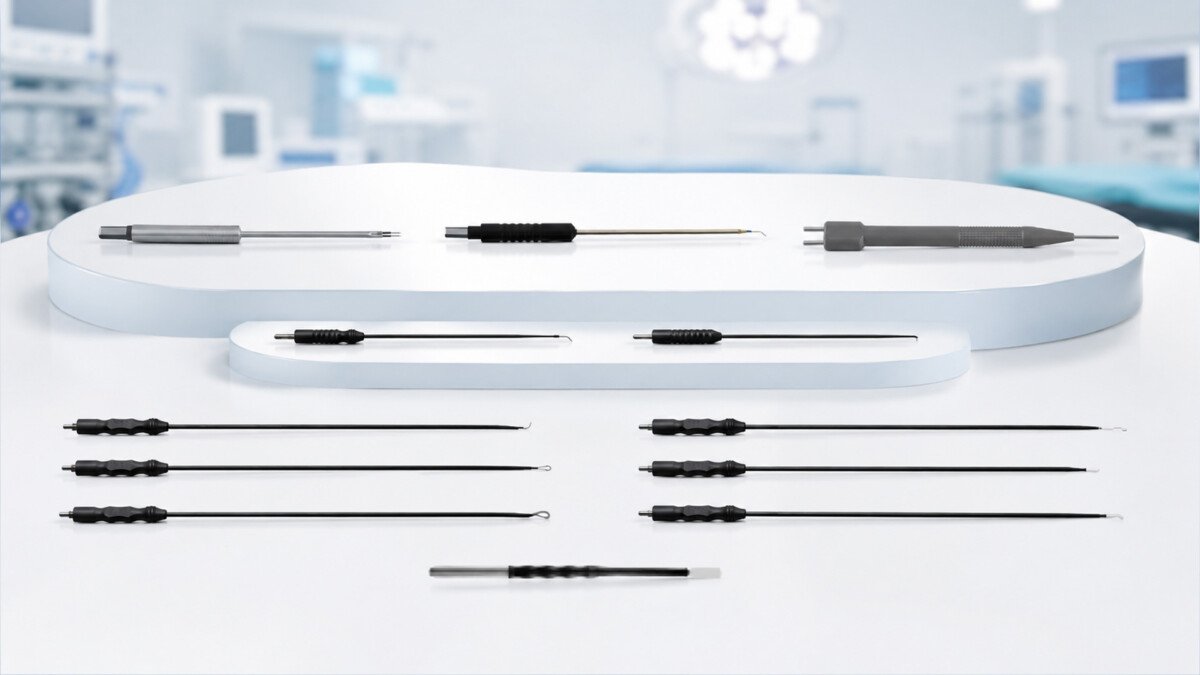
“Diathermy electrode” is widely understood in purchasing conversations, but it can refer to several distinct products. A short monopolar electrode for open surgery, an arthroscopic electrode, a bipolar ENT electrode with cable and a laparoscopic hook electrode should not be grouped under one vague specification. The buyer’s task is to translate the general request into an exact energy modality, electrode form, shaft and connection requirement.
A diathermy electrode should be selected by confirming whether the requirement is monopolar or bipolar, then recording electrode form, shaft diameter, length, cable arrangement and compatible HF equipment. Seemann Technologies publishes single-use monopolar electrodes, arthroscopic electrodes, ENT bipolar electrodes with cable and monopolar electrodes for laparoscopy within its verified HF and MIS ranges.
Diathermy electrode and electrosurgical electrode: useful market terms, not complete specifications
Hospitals and distributors may use “diathermy” and “electrosurgery” when describing the same broad purchasing area. The terminology is less important than the information that follows it. A usable enquiry must identify the product category and distinguish monopolar from bipolar technology.
Seemann organises its open-surgery selection under monopolar electrodes. The category also includes a separate bipolar ENT product group. That structure should be preserved in product records: an ENT bipolar electrode should not be renamed as a monopolar product merely because it appears within the broader electrode section.
Verified Seemann electrode families
Short and long monopolar electrodes
Seemann lists sterile single-use monopolar electrodes in short and long configurations with published shaft diameters of 2.4 mm and 4 mm. Within those groups, buyers should identify the required electrode form and exact dimensions from the current reference specification.
“Short” or “long” is helpful for navigating a catalogue, but it should not replace a numerical length in a tender, item record or comparison. Shaft diameter and electrode connection must also be recorded.
Arthroscopic electrodes
The verified range includes single-use monopolar arthroscopic electrodes with 2.4 mm and 4 mm shaft categories. Arthroscopic products should remain clearly separated from open-surgery and laparoscopic electrodes because the broader labels do not establish equivalent dimensions or connections.
Tungsten electrodes
Seemann publishes a single-use monopolar tungsten electrode with an insulated 4 mm shaft. Material descriptions can be commercially relevant, but they should be stated only where they form part of the current product information. A buyer should still request the complete reference specification rather than treating “tungsten” as the entire selection criterion.
Conisation electrodes
Single-use monopolar conisation electrodes are listed with 2.4 mm and 4 mm shaft categories. Their specialised designation should be retained in catalogues and enquiries. No general clinical suitability claim should be inferred from the category name alone.
ENT bipolar electrodes with cable
The Seemann selection includes single-use bipolar electrodes with a 5 m cable for ENT. This is a bipolar electrode product, not a monopolar forceps and not a generic cable accessory. Buyers should confirm the exact electrode configuration and the equipment-side connection required for their HF system.
Laparoscopic monopolar electrodes
Seemann’s single-use MIS instrument information identifies monopolar electrodes for laparoscopy, including hook-electrode products within the wider published range. Laparoscopic enquiries should state the required electrode profile, working length, shaft dimensions and connector information.
How the electrode categories compare
| Electrode category | Verified Seemann description | Essential enquiry details |
| Open-surgery monopolar | Short and long ranges with 2.4 mm and 4 mm shaft categories | Electrode form, shaft diameter, length and handle connection |
| Arthroscopic monopolar | Single-use electrode ranges with 2.4 mm and 4 mm shafts | Exact reference, shaft, tip form and equipment connection |
| Tungsten monopolar | Single-use tungsten electrode with insulated 4 mm shaft | Exact geometry, dimensions and connection |
| Conisation monopolar | Single-use 2.4 mm and 4 mm shaft categories | Product reference, dimensions and equipment interface |
| ENT bipolar | Single-use bipolar electrodes with 5 m cable for ENT | Electrode configuration, cable plug and HF equipment model |
| Laparoscopic monopolar | Monopolar electrodes for laparoscopy within the MIS range | Tip profile, shaft, working length and connection |
Shaft diameter and length are separate decisions
An electrode shaft influences how the product is identified and connected, while length defines another part of the physical specification. Product records should not merge these measurements or use “long shaft” without a numerical reference. When comparing an existing electrode with a proposed alternative, capture both the shaft diameter and the relevant working or total length shown in the approved documentation.
This matters particularly where a supplier offers several electrode forms within the same shaft category. The common shaft diameter does not make the tips interchangeable, nor does it confirm that they share the same intended use.
Electrode form must be described accurately
Terms such as needle, knife, ball, loop and hook may appear across electrosurgical catalogues. Each describes a different physical form. Buyers should use the name given in the current manufacturer documentation and avoid choosing a product from a generic image or an approximate description.
A distributor building an electrode catalogue should store electrode form, modality, shaft diameter, length and connection as separate fields. That structure helps users filter products without encouraging them to assume that visually similar electrodes are equivalent.
Seemann procurement insight: The fastest way to narrow an electrode enquiry is to provide the current electrode reference together with one clear image of the complete instrument and one close image of its connector.
Compatibility involves the entire connection path
A monopolar electrode may connect through an HF handle, while a cable-connected bipolar electrode follows a different arrangement. The buyer should map every component between the instrument and the HF equipment rather than assuming that a familiar tip or plug confirms compatibility.
Seemann’s wider single-use HF technology overview identifies HF handles with cables and electrodes among its core products. Where a handle is part of the system, the enquiry should include the electrode-to-handle interface, control arrangement, cable and equipment-side connector.
A buyer checklist for electrode selection
- Identify the modality. State clearly whether the request is monopolar or bipolar.
- Name the product family. Open-surgery, ENT, arthroscopic and laparoscopic categories should remain distinct.
- Describe the electrode form. Use the manufacturer’s current term and provide the existing reference where possible.
- Record the shaft. Include diameter, relevant length and any insulation information shown in the specification.
- Map the connection. Identify the handle, cable and HF equipment interfaces involved.
- Confirm the supply format. Request current sterile status, packaging, shelf life and order configuration for the exact reference.
- List required evidence. Specify product, labelling, instructions-for-use and conformity documents needed for evaluation.
Documentation and product approval
Professional buyers may need a current product specification, label information, packaging details, instructions for use where applicable and relevant conformity documentation. Requirements vary by product, destination market and the buyer’s role. Seemann’s quality information can support the supplier review, while reference-specific documents should be requested separately.
Where a hospital is considering a new reference, its normal clinical and technical approval process should determine whether a sample evaluation is required. Product content can support purchasing research, but it must not replace the manufacturer’s instructions or the organisation’s approval controls.
Preparing a clear distributor or hospital enquiry
A complete enquiry reduces unnecessary exchanges and makes a useful quotation more likely. Include:
- product family and monopolar or bipolar requirement;
- electrode form and current product reference;
- shaft diameter and required length;
- handle, cable and connector details;
- HF equipment manufacturer and model;
- required documentation and sample information;
- destination country and buyer type; and
- estimated quantity or annual demand.
Buyers comparing connected categories can review Seemann’s wider product portfolio, which separates single-use HF, minimally invasive and reusable HF instrument groups.
Why terminology accuracy matters in product data
Electrode records often pass through several systems: manufacturer catalogue, distributor database, hospital procurement platform and local stock record. Each transfer creates an opportunity to lose a critical word such as bipolar, arthroscopic or laparoscopic.
Retain the complete manufacturer name and reference, then store modality, electrode form, shaft and length in separate fields. Correct spelling matters too: use “ENT Bipolar Electrode” consistently. Accurate product data improves catalogue navigation and reduces the chance that a customer receives an apparently similar but different category.
When an existing product is being replaced
Ask the buyer for the current reference and establish which features must match. The comparison may include modality, electrode form, material description where relevant, shaft dimensions, connection and supply format. Any proposed change should follow the hospital or distributor’s established approval route and rely on current documentation rather than informal equivalence claims.
Frequently Asked Questions
What is a diathermy electrode?
It is a common commercial term for an electrode used with compatible electrosurgical or HF equipment. The exact specification must identify modality, electrode form, dimensions and connection.
Does Seemann offer single-use monopolar electrodes?
Yes. The published selection includes short and long monopolar electrode ranges, arthroscopic electrodes, a tungsten electrode and conisation electrodes.
Does Seemann offer an ENT bipolar electrode?
The verified range includes single-use bipolar electrodes with a 5 m cable for ENT. Buyers should request the current product and connector specification for the exact reference.
Are electrode shaft diameter and electrode length the same measurement?
No. Shaft diameter and length describe different physical attributes and should be recorded separately.
Can an electrode be selected from its tip shape alone?
No. Modality, shaft, length, connection, equipment compatibility and the full reference specification are also necessary.
What compatibility information should a buyer provide?
Provide the HF equipment manufacturer and model, current electrode or handle reference, connector details and photographs where useful. The exact combination should be confirmed using current documentation.
Can buyers request samples and specifications?
Hospitals and distributors can ask Seemann about available samples, specifications, packaging information and commercial terms for the references they are evaluating.
Discuss Your Product Requirements
Send Seemann Technologies the required electrode family, modality, electrode form, shaft dimensions, connection details, HF equipment reference, destination and expected quantity. The team can then discuss relevant product information and the documents required for a structured evaluation.
Request electrode specifications, sample information or a quotation.