
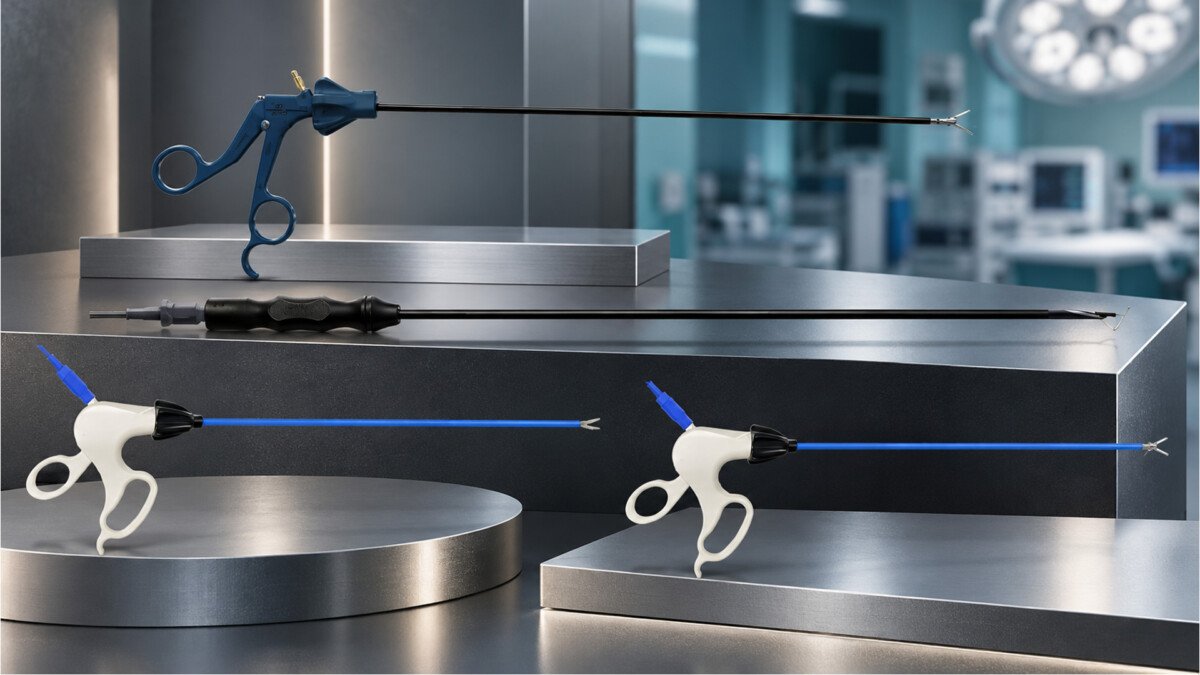
 ⚡ Laparoscopic electrosurgery brings two specifications together: the physical design required for minimally invasive access and the electrical configuration required by the HF system.
Laparoscopic Electrosurgical Instruments include minimally invasive products that use monopolar or bipolar high-frequency technology within a laparoscopic setup. For professional buyers, this creates a more detailed specification than either “laparoscopic instrument” or “electrosurgical instrument” alone.
The instrument may need a defined shaft diameter and working length for access, a specific jaw or electrode tip for the working end, and a compatible electrical connection for the HF system.
Seemann Technologies’ current single-use MIS portfolio includes bipolar dissection and grasping forceps, bipolar scissors, monopolar dissection and grasping forceps, monopolar scissors and monopolar electrodes for laparoscopy.
What Are Laparoscopic Electrosurgical Instruments?
Electrosurgical Instruments for Laparoscopy combine minimally invasive instrument geometry with an HF energy configuration.
The category can include:
- Bipolar grasping/dissection forceps
- Bipolar scissors
- Monopolar grasping/dissection instruments
- Monopolar scissors
- Monopolar laparoscopic electrodes
Each category should retain its own distinct product specification.
Bipolar Laparoscopic Instruments
Bipolar Laparoscopic Instruments use a bipolar configuration within a long-shaft MIS instrument design.
The buyer may need to specify:
- jaw or blade pattern;
- shaft diameter;
- working length;
- bipolar connection;
- cable arrangement;
- current reference.
Seemann currently lists bipolar dissection/grasping forceps and bipolar scissors within its MIS range.
Monopolar Laparoscopic Instruments
Monopolar Laparoscopic Instruments form another distinct category.
The Seemann MIS range currently includes monopolar dissection/grasping forceps, monopolar scissors and monopolar electrodes for laparoscopy.
A buyer should record the working-end design and electrical connection separately.
Bipolar Grasping Forceps
One current Seemann product example is a single-use fenestrated bipolar grasping forceps with a 5 mm diameter and 330 mm working length.
This demonstrates the type of reference-level information that should appear on professional product pages:
- jaw design;
- diameter;
- working length;
- energy configuration;
- reference number.
Monopolar Hook Electrodes
Monopolar hook electrodes represent another important laparoscopic electrosurgical category.
The working-end hook identifies the basic electrode type, but procurement should also confirm:
- shaft diameter;
- working length;
- insulation;
- proximal connection;
- HF handpiece.
Laparoscopic Electrosurgical Scissors
Seemann Technologies’ current MIS portfolio includes both bipolar and monopolar scissors.
The company’s product showcase also includes a single-use curved Metzenbaum scissor with a 5 mm diameter and 330 mm working length.
For purchasing, blade geometry and energy configuration should be recorded independently.
Working Length Is a Core MIS Specification
Laparoscopic instrument design requires working length to be treated as a primary specification field.
Distributors should avoid catalogues that list only:
“long bipolar forceps”
or:
“laparoscopic monopolar electrode”.
Where available, the exact working length should be displayed.
Shaft Diameter Should Not Be Hidden in the Description
Shaft diameter should appear as a structured specification rather than being buried inside a paragraph.
A strong product table includes:
- reference;
- instrument family;
- diameter;
- working length;
- working-end configuration;
- HF connection.
Bipolar vs Monopolar in Laparoscopic Procurement
| Specification Area | Bipolar MIS Instruments | Monopolar MIS Instruments |
| Current Seemann categories | Grasping/dissection forceps, scissors | Grasping/dissection forceps, scissors, electrodes |
| Working end | Jaw/blade configuration | Jaw, blade or electrode tip |
| Shaft | Diameter and working length | Diameter and working length |
| Electrical specification | Bipolar connection | Monopolar connection |
| Best starting point | Existing reference and HF setup | Existing reference and HF setup |
Do Not Present Bipolar vs Monopolar as a Universal Winner
These technologies represent different electrosurgical configurations.
A professional procurement page should explain how their specifications differ without presenting one system as universally better.
The healthcare organisation’s approved clinical and equipment requirements should determine the appropriate product configuration.
HF Equipment Connection
Electrical connection remains important even after the physical instrument has been identified.
Professional buyers should provide:
- current instrument reference;
- existing cable or handpiece reference;
- HF generator manufacturer/model;
- required connector information.
This allows compatibility to be evaluated using defined product information rather than assumptions.
Single-Use Laparoscopic Instruments
Seemann Technologies specialises in Single-Use Laparoscopic Instruments and other single-use HF/MIS products.
Reference-specific procurement may therefore also involve:
- sterile presentation;
- packaging;
- shelf-life information;
- storage requirements;
- product labelling;
- instructions for use.
Laparoscopic Electrosurgical Instrument Checklist
| Field | Buyer Requirement |
| Energy type | Monopolar or bipolar |
| Instrument family | Forceps, scissors, electrode or other MIS product |
| Current reference | Existing approved product |
| Working end | Jaw, blade or electrode-tip configuration |
| Shaft diameter | Exact documented measurement |
| Working length | Exact documented measurement |
| HF connection | Cable, handpiece or equipment-side requirement |
| Usage model | Confirm single-use requirement |
Build the Product Architecture Around Real Instrument Families
From an SEO perspective, a central Laparoscopic Electrosurgical Instruments guide should connect rather than compete with product-specific pages.
The preferred structure is:
Laparoscopic electrosurgical hub
→ Bipolar laparoscopic grasping forceps
→ Laparoscopic scissors
→ Monopolar hook electrodes
→ Single-use MIS instruments
This gives each URL a distinct role.
Related Product Guides
- Single-Use MIS Instruments
- Bipolar Laparoscopic Grasping Forceps
- Monopolar Hook Electrode for Laparoscopy
- Single-Use Laparoscopic Scissors
- Laparoscopic Instrument Procurement Guide
Frequently Asked Questions
Which laparoscopic electrosurgical categories does Seemann Technologies offer?
The current single-use MIS range lists bipolar dissection/grasping forceps, bipolar scissors, monopolar dissection/grasping forceps, monopolar scissors and monopolar electrodes for laparoscopy.
What specifications matter most?
Important fields include energy configuration, working-end design, shaft diameter, working length and HF connection.
Does Seemann provide both monopolar and bipolar MIS instruments?
Yes. Both technologies are represented within the company’s current single-use MIS product portfolio.
Are single-use laparoscopic instruments supplied sterile?
Seemann’s current MIS technology page describes its single-use MIS instruments as delivered sterile. Reference-specific information should still be checked before ordering.
Request Laparoscopic Electrosurgical Product Information
Seemann Technologies provides Laparoscopic Electrosurgical Instruments across monopolar and bipolar single-use MIS categories.
Provide the existing reference, energy configuration, shaft diameter, working length and equipment information for a focused product discussion.