
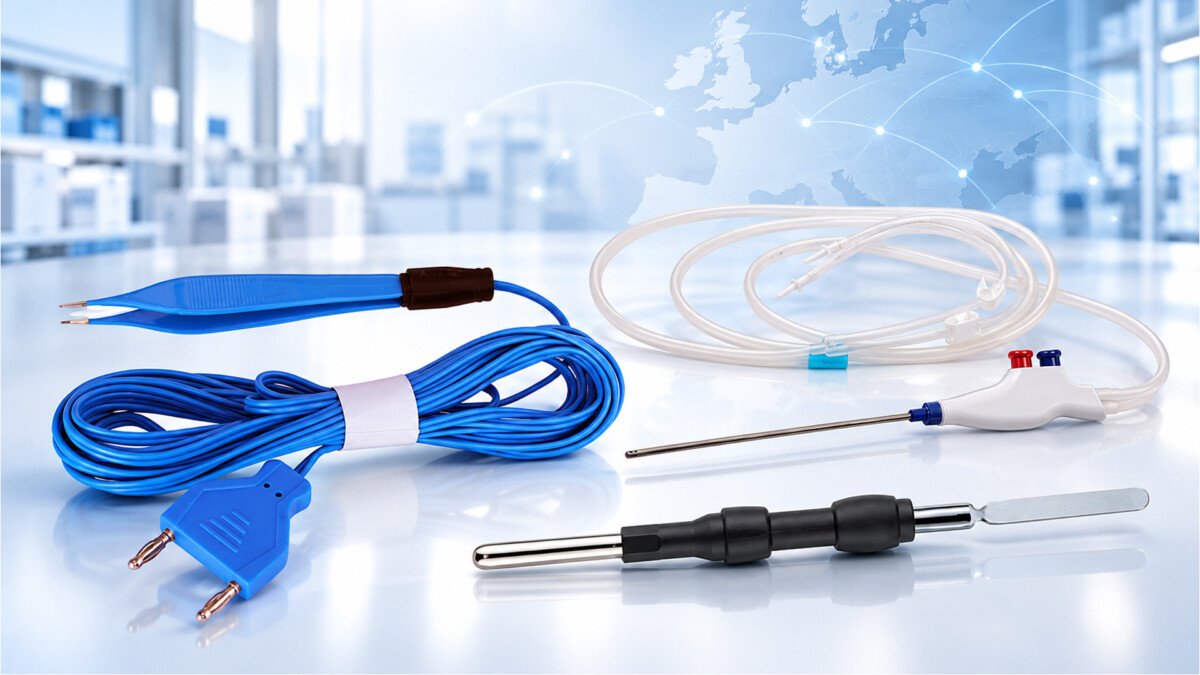
 🌍 A good distributor relationship starts before the first order. Product clarity, documentation, technical communication and a well-structured range can matter as much as the quoted unit price.
Medical Device Sourcing for European Distributors requires more than finding a manufacturer with a broad catalogue.
Medical device distributors need products they can understand, present clearly to hospital customers and support with appropriate technical and quality information.
For surgical and electrosurgical product categories, this means evaluating the supplier’s product structure, technical communication, reference consistency, documentation processes and ability to support connected instrument systems.
Seemann Technologies provides single-use HF and MIS instrument categories for professional healthcare markets in Europe, including bipolar forceps, monopolar electrodes, bipolar cables and minimally invasive surgical instruments.
Start With Product-Market Fit
Before discussing prices, a distributor should establish whether the manufacturer’s range fits the needs of its customer base.
Questions include:
- Does the product range match the procedures and hospitals we serve?
- Are the main product families clearly organised?
- Can the products be explained easily by our sales team?
- Are technical references consistent?
- Does the manufacturer provide enough information for buyer evaluation?
A smaller but well-structured range can sometimes be easier to commercialise than a large catalogue with unclear categories.
Evaluate the Supplier’s Core Product Strength
A distributor should understand where the manufacturer has genuine product depth.
For Seemann Technologies, the published portfolio has a strong focus on:
- Single-Use HF Instruments
- Single-Use MIS Instruments
- Bipolar Forceps
- Monopolar Electrodes
- Bipolar Forceps Cables
A distributor can then evaluate whether those categories complement its existing portfolio.
Product Specifications Must Be Easy to Work With
Technical information is one of the most important factors in medical device sourcing.
A distributor often acts as the communication link between the manufacturer and the hospital.
If product information is unclear, every enquiry takes longer.
Strong product communication should make it easy to identify:
- Reference number
- Product family
- Dimensions
- Tip/jaw configuration
- Shaft diameter
- Working length
- Cable or connector requirements
- Packaging information where relevant
Look for Consistent Product References
Reference consistency is essential for distributor operations.
The same product number should be traceable across:
- Manufacturer catalogue
- Quotation
- Technical documentation
- Distributor ERP or catalogue
- Hospital quotation
- Purchase order
Consistent references reduce the risk of product confusion during repeat orders.
Check Connected Product Categories
Electrosurgical instruments should not always be evaluated in isolation.
For example:
Bipolar Forceps → Bipolar Cable → HF Equipment
or:
Monopolar Electrode → HF Handle → Cable → HF Equipment
A distributor benefits when the supplier can explain these relationships clearly.
This makes it easier to prepare complete hospital quotations and prevents missing accessories from being discovered later.
Documentation Should Be Easy to Request
Hospitals, procurement teams and distributor quality departments may need supporting product documentation.
The exact requirement depends on the product and market, but the supplier should have a clear process for responding to documentation requests.
Distributors may need access to:
- Technical specifications
- Instructions for use
- Product catalogue information
- Packaging information
- Current quality documentation
- Applicable conformity documentation
Any regulatory claim used in distributor marketing should match the manufacturer’s current approved documentation.
Do Not Evaluate a Manufacturer Only by SEO Claims
Search terms such as Medical Device Manufacturer Europe, Electrosurgical Instruments Supplier or Surgical Instrument Supplier for Distributors are useful for supplier discovery.
But the sourcing decision should move quickly from search marketing to evidence.
Review:
- Real products
- Actual references
- Current documentation
- Technical responsiveness
- Commercial communication
- Supply capability
A manufacturer website should support that transition rather than relying only on repeated commercial keywords.
Assess the Supplier’s Response Quality
A distributor should pay attention to how well the manufacturer handles technical enquiries.
A useful response should clarify missing information rather than guessing.
For example, if a buyer requests “bipolar forceps”, the supplier may need to ask about:
- Pattern
- Length
- Tip requirement
- Non-stick configuration
- Cable
- Equipment connection
This type of clarification is a positive sourcing signal because it shows that the supplier treats the product as a technical specification rather than just a catalogue name.
Evaluate Portfolio Expansion Potential
A new distributor relationship may begin with one product family and expand over time.
For example, a distributor sourcing bipolar forceps may later evaluate:
- Monopolar electrodes
- Bipolar cables
- HF handles
- Single-use MIS instruments
- Laparoscopic instrument categories
A coherent product architecture can therefore support longer-term catalogue development.
Country-Specific Market Planning
European medical distribution is not one uniform market.
Commercial communication, language, procurement processes and hospital structures differ between countries.
Seemann Technologies currently develops market-focused content for regions including Belgium, Spain and Ireland.
For distributors, the important point is to maintain consistent technical product identity even when marketing language changes between countries.
Commercial Terms Matter—But Only After Product Alignment
Price, lead time, quantities and payment terms are important commercial factors.
However, they should be compared only after the product references are technically aligned.
A cheaper quotation may not be genuinely comparable if:
- It excludes the required cable
- It uses a different shaft diameter
- It provides a different instrument pattern
- It represents a reusable instead of single-use product
Distributor Supplier Evaluation Checklist
| Evaluation Area | What to Check |
| Product fit | Does the range match customer demand? |
| Technical clarity | Are specifications and references clear? |
| Connected products | Are cables, electrodes and accessories easy to identify? |
| Documentation | Can required product information be supplied? |
| Communication | Are technical questions answered accurately? |
| Supply | Can the manufacturer discuss quantities and availability clearly? |
| Market support | Can the products be presented effectively to hospitals and buyers? |
Questions to Ask a Potential Surgical Instrument Supplier
Before adding a new supplier to the portfolio, distributors can ask:
- Which product categories do you manufacture or supply directly?
- Which products are your strongest core categories?
- Can you provide reference-level technical information?
- How are compatibility questions handled?
- Which documents are available for product evaluation?
- How should quotations be requested?
- What information do you need from hospital customers?
- Can related product categories be quoted together?
Why Product-Focused Content Supports Better Distributor Relationships
A manufacturer’s website should help distributors prepare before contacting the sales team.
Clear category pages, specification guides and compatibility content reduce basic clarification and allow commercial discussions to begin at a more useful level.
This is why high-quality SEO content should not exist only to attract traffic.
It should help the distributor make a better sourcing decision.
Frequently Asked Questions About European Medical Device Sourcing
What should medical distributors evaluate first?
Start with product-market fit, technical product depth, reference clarity and the supplier’s ability to provide appropriate supporting information.
Why are exact product references important?
References allow the same product to be identified consistently across catalogues, quotations, documentation and purchase orders.
Should distributors compare suppliers only on price?
No. Products should first be aligned technically so that commercial comparisons are meaningful.
Which product categories does Seemann Technologies focus on?
The current portfolio emphasises single-use HF and MIS instruments, including bipolar forceps, monopolar electrodes, bipolar cables and related surgical categories.
Discuss Distributor Opportunities With Seemann Technologies
For organisations involved in Medical Device Sourcing for European Distributors, Seemann Technologies provides a focused portfolio of single-use HF and MIS products for professional healthcare supply.
Distributors can contact the company with product references, target categories, expected quantities and market requirements to begin a structured commercial discussion.