
 A procurement guide for building accurate specifications, quotations and repeat-supply requirements
Single-use forceps are often evaluated by people with different priorities. Clinical users focus on the configuration they expect to handle; procurement teams need a precise and comparable specification; distributors need product data that can be quoted and reordered without ambiguity. A strong supply decision brings these requirements together before the first sample or order is requested.
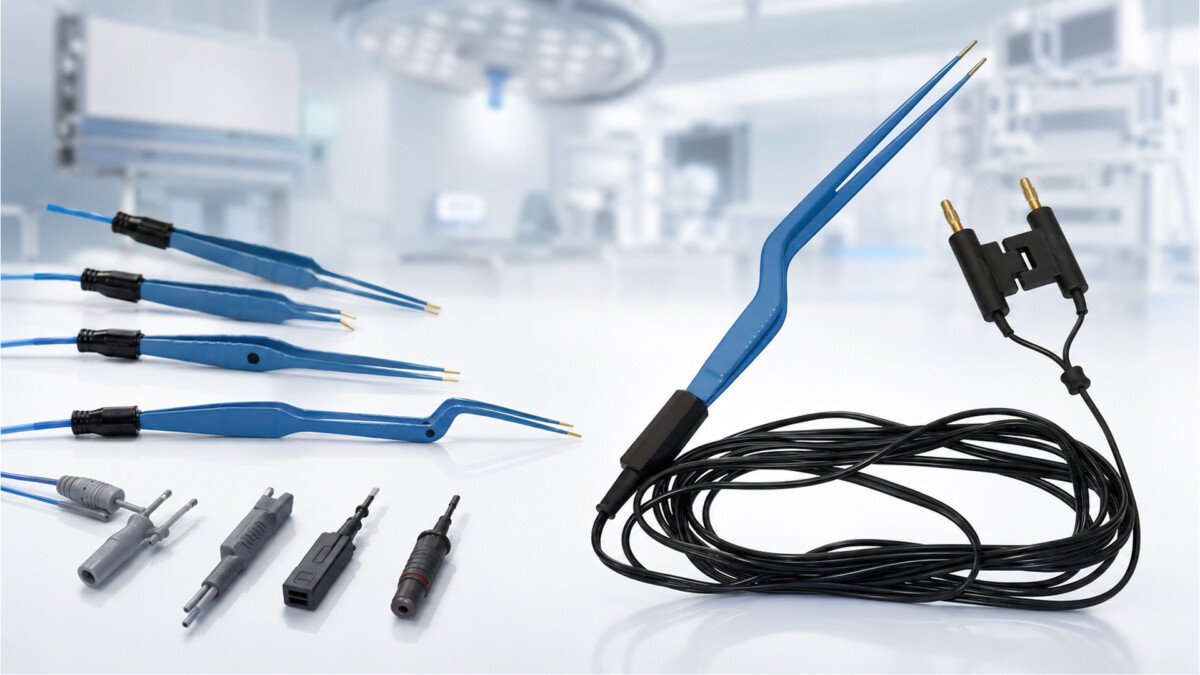
When sourcing single-use forceps for electrosurgical supply, buyers should specify the exact forceps family, pattern, tip, length, non-stick requirement and cable configuration. Seemann Technologies publishes sterile single-use bipolar forceps in straight, angled-tip and bayonet designs, with additional non-stick, cable-connected and irrigation options.
Define the product before discussing supply
“Single-use forceps” is a useful product-family description, but it is not a complete order specification. Within electrosurgical procurement, the request should state whether the buyer needs single-use bipolar forceps, a minimally invasive grasping or dissection instrument, or another defined category. Electrodes should remain recorded as electrodes; they must not be relabelled as forceps simply because both products sit within an HF portfolio.
Seemann’s open-surgery bipolar forceps selection provides a clear example of why the distinction matters. The range is organised by pattern and product feature, including standard, non-stick, cable-connected and irrigation configurations. Each option answers a different specification.
Verified bipolar forceps options from Seemann Technologies
Straight, angled-tip and bayonet models
The published range includes a conventional straight model, a straight model with an angled tip and a bayonet model. These names describe visible geometry, but professional buyers should also compare total length and tip information from the current product specification.
Non-stick configurations
Non-stick versions are listed in straight, angled-tip and bayonet forms. A non-stick designation should be carried accurately through catalogue records, quotation lines and customer orders. It is a defined product characteristic, not a general synonym for premium forceps.
Forceps supplied with cable
Seemann lists straight and bayonet single-use bipolar forceps supplied with a 5 m cable and 2-pin connector. A cable-connected product can simplify a particular supply requirement, but only when the equipment-side connection matches the buyer’s documented HF equipment setup.
Forceps with irrigation
A sterile irrigation configuration also appears in the published range. Because it represents a specialist product arrangement, buyers should request the current specification and confirm all connection and supply details rather than extrapolating from standard forceps.
How product selection affects the quotation
| Buying decision | Why it changes the quotation | Useful evidence |
| Standard or non-stick | Identifies a different forceps variant | Approved specification or current reference |
| Straight, angled-tip or bayonet | Defines the physical pattern | Pattern name, dimensions and product image |
| Forceps with cable | Adds a defined cable and connector arrangement | HF equipment model and connector details |
| Separate cable | Requires an additional compatible reference | Instrument-side and equipment-side interfaces |
| Sample request | May follow a different approval route from commercial supply | Evaluation objective, quantity and delivery location |
| Repeat supply | Requires forecasting and order-configuration discussion | Expected demand and ordering frequency |
Integrated cable or separate bipolar cable?
Both approaches can be relevant, but the difference should be explicit in the purchasing record. An integrated cable is part of the specified forceps configuration. A separate bipolar forceps cable is its own product reference and needs its own compatibility check.
For separate cables, Seemann publishes 5 m options with different connector arrangements. Its technical information on single-use bipolar cables also describes several equipment-side connector families. These descriptions help buyers frame the enquiry, but they do not make all cables universally interchangeable.
The most reliable approach is to provide:
- the HF equipment manufacturer and exact model;
- the current forceps reference;
- the current cable reference, if available;
- clear images of the connection points;
- the preferred cable length and connector orientation; and
- the reference-level compatibility evidence required by the buyer.
Seemann procurement insight: Recording the forceps and cable as two linked references makes repeat ordering more dependable, even when both products were first discussed as one operating-room requirement.
Single-use supply involves more than the instrument
Product selection is only one part of a supply decision. Hospitals and distributors may need to assess sterile presentation, unit packaging, outer packaging, labelling, shelf life, storage conditions and product identification. The current values should be obtained for the exact reference under review.
For a distributor, these details affect warehouse records, customer quotations and stock rotation. For a hospital, they can affect internal item setup and approval. A product-family statement cannot substitute for reference-specific documentation.
A practical approval route for professional buyers
- Capture the existing requirement. Obtain the current reference, specification and equipment information from the customer or clinical department.
- Map the essential attributes. Separate pattern, tip, length, non-stick status and connection into individual fields.
- Shortlist the relevant Seemann reference. Compare against the published single-use HF instrument range and current catalogue.
- Request documentation. Ask for available product, packaging and conformity information needed for the buyer’s review.
- Plan any sample evaluation. State what the organisation needs to assess and follow its normal approval process.
- Confirm commercial supply. Verify quantity, packaging configuration, availability, lead time, destination and repeat-order expectations.
Questions distributors should settle before adding a reference
A distributor needs a product record that remains useful after the first salesperson or customer has moved on. The record should make it possible to identify the reference without relying on a photograph alone.
- Is the product name consistent with Seemann’s current catalogue?
- Are the pattern and non-stick status stored separately?
- Are length and tip details searchable?
- Is a cable included, separate or not required for that reference?
- Which equipment and connector information must a customer supply?
- Which product and conformity documents are available?
- What are the confirmed unit, pack and case arrangements?
- How will forecast changes and repeat orders be communicated?
Connected products without category confusion
Hospitals reviewing single-use forceps may also require electrodes, cables or minimally invasive instruments. Seemann’s product overview helps buyers see how open-surgery HF, minimally invasive HF and reusable HF categories sit alongside one another.
Those connections can support a broader supply conversation, but each product should retain its proper name and specification. A monopolar electrode is not a forceps, and a bipolar cable should not be assumed compatible merely because it belongs to the same portfolio.
Documentation and supplier evaluation
Depending on the organisation and market, buyers may request product specifications, label details, instructions for use where applicable, packaging information and current conformity documentation. Seemann’s quality information offers company background; current evidence for the exact product should form part of the commercial review.
Commercial capability also needs confirmation. Availability, minimum quantities, delivery timing and any distributor, OEM or private-label arrangements should be discussed directly and should never be inferred from a broad product listing.
Forecasting repeat supply without creating false certainty
Forecasts help a supplier understand demand, but they should distinguish firm orders from expected consumption. A distributor can share recent customer usage, anticipated new-account demand and preferred ordering frequency while making clear which figures remain estimates.
Hospitals may also benefit from recording practical reorder points against their own usage and storage capacity. The supplier should confirm current lead time and availability for each purchase; an earlier delivery should not be treated as a permanent promise.
Building a focused distributor assortment
A useful starting assortment does not need every available configuration. It should reflect real customer specifications and maintain a clear route to less frequently requested variants. Straight, angled-tip, bayonet, non-stick and cable-connected options can be presented as a structured family, with the exact catalogue references and commercial availability confirmed by Seemann.
Grouping compatible forceps and cables in sales information can help customers understand the system requirement, provided each component remains a separate, identifiable product. This balance supports cross-category enquiries without encouraging automatic compatibility assumptions.
Frequently Asked Questions
Which single-use forceps does Seemann Technologies publish?
The verified open-surgery selection includes single-use bipolar forceps in straight, angled-tip and bayonet patterns, including non-stick variants, cable-connected models and an irrigation configuration.
Does “single-use forceps” mean the same as “single-use electrode”?
No. Forceps and electrodes are different product categories. Their names, specifications and connection requirements should remain separate.
Can single-use bipolar forceps be supplied with a cable?
Seemann lists selected straight and bayonet models with a 5 m cable and 2-pin connector. Confirm the exact reference and equipment connection before ordering.
What should a buyer include in a sample request?
Include the shortlisted reference, evaluation objective, required quantity, delivery destination and the organisation’s approval requirements. Sample availability and terms should be confirmed directly.
How should repeat demand be communicated?
Share a realistic forecast, ordering frequency, destination market and any pack or case requirements. Request current availability and lead-time information at quotation stage.
What documents can a distributor request?
A distributor may request available specifications, labelling and packaging information, instructions for use where applicable and current conformity documentation for the exact reference.
How can a buyer begin a product comparison?
Use the current product or tender specification, record the essential attributes and send the information through the Seemann Technologies contact form.
Discuss Your Product Requirements
For a useful response, include the forceps type, pattern, tip and length requirements, non-stick preference, cable arrangement, HF equipment model, destination country and estimated volume. Seemann Technologies can then discuss relevant references, available documentation, sample information and quotation requirements.