
 Choose the forceps and its connection as one clearly documented purchasing requirement
Cable-connected bipolar forceps can simplify a product enquiry, but only when the complete configuration has been identified. The forceps pattern, length and tip remain important, while the cable introduces another set of questions involving length, plug type and compatibility with the installed HF equipment. Treating these details as one connected specification gives hospitals and distributors a clearer route from comparison to repeat supply.
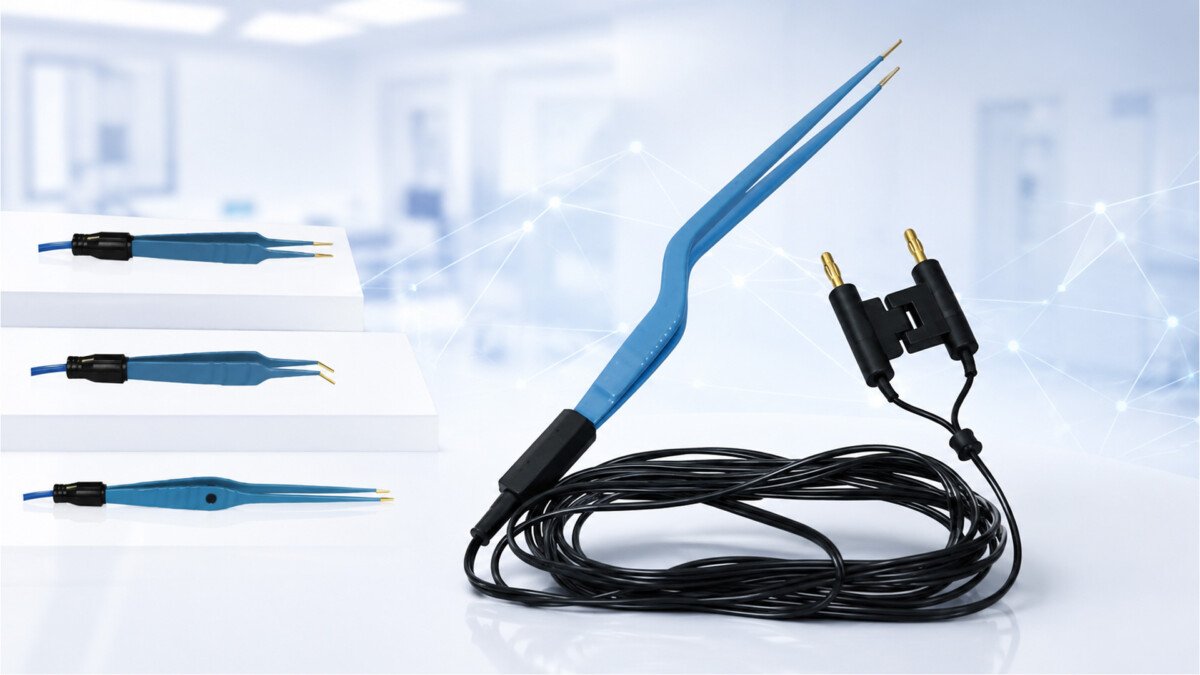
Single-use bipolar forceps with cable should be selected by confirming the forceps pattern, instrument length, tip specification, cable length, equipment-side connector and HF equipment model. Seemann Technologies publishes sterile straight and bayonet forceps with a 5 m cable and 2-pin connector; the exact reference and compatibility should be confirmed before purchase.
Why the cable changes the buying decision
A standard bipolar forceps enquiry can be divided into two product references when the cable is supplied separately. With a cable-connected configuration, the instrument and its cable are presented together under a defined product arrangement. That can make item setup more straightforward, but it does not remove the need for compatibility verification.
The live Seemann bipolar forceps range lists cable-connected straight and bayonet models alongside standard, non-stick and irrigation configurations. Keeping these groups separate helps buyers avoid ordering a familiar pattern with the wrong connection arrangement.
Verified Seemann cable-connected configurations
Straight forceps with 5 m cable
Seemann publishes a sterile straight-model category supplied with a 5 m cable and 2-pin connector. The current product selection includes several named straight patterns and lengths. These details show why “straight forceps with cable” is still too broad for a final quotation.
Professional buyers should request the full product specification for the shortlisted reference, including the forceps pattern, total length, tip dimensions and connector description. Current availability should be confirmed directly rather than assumed from a catalogue listing.
Bayonet forceps with 5 m cable
A separate sterile bayonet category is also published with a 5 m cable and 2-pin connector. The verified selection includes more than one length, so the pattern name and cable description do not identify the reference by themselves.
Where a buyer is replacing an established bayonet forceps, the most useful starting information is the current manufacturer reference, approved length and tip specification, followed by the HF equipment model and connector evidence.
Forceps with cable and separate cable are different supply routes
| Supply arrangement | How it is identified | What the buyer must confirm |
| Forceps supplied with cable | One defined cable-connected forceps configuration | Pattern, length, tip, cable length, plug and HF equipment |
| Forceps and separate cable | Two linked product references | Forceps interface, both cable ends, cable length and equipment model |
| Existing reusable cable | Instrument must be assessed against an installed cable reference | Documented compatibility for the exact cable and forceps combination |
Seemann also publishes single-use bipolar forceps cables as separate products. A buyer should decide which route matches the hospital’s item structure and equipment setup before requesting prices.
Understanding the 2-pin connector description
A connector name is an important identifier, but it should not be treated as proof of universal compatibility. The current Seemann cable-connected forceps categories use a 2-pin connector description, and individual published products include references described for international models. The exact plug geometry and equipment match should still be verified.
Provide the HF equipment manufacturer and model, a clear image of the relevant socket and the existing forceps or cable reference. If the organisation requires a formal compatibility statement or other supporting evidence, identify that requirement during the enquiry.
Seemann procurement insight: Record the cable-connected forceps as a complete approved reference, but keep pattern, length, tip and connector in separate searchable fields for future comparisons.
Pattern and length remain central
The presence of a cable should not distract from the instrument itself. Straight and bayonet designs provide different physical configurations, and each may be offered in more than one length. Tip dimensions and pattern names should come from the current product specification.
For a replacement enquiry, do not rely only on photographs. A visually similar forceps may differ in length, tip, connector or another documented attribute. Comparison should follow the hospital or distributor’s established approval process.
Single-use packaging and item setup
Because the forceps and cable are supplied together, buyers need to understand how the complete configuration is packaged and identified. Request current information on sterile presentation, unit packaging, outer packaging, shelf life, storage conditions and order quantities for the exact reference.
Distributors should ensure that catalogue and warehouse descriptions clearly indicate that a cable is included. This prevents the product from being confused with a forceps that requires a separate cable and reduces the risk of quoting an incomplete setup.
Buyer checklist for cable-connected bipolar forceps
- Name the pattern. State whether the requirement is straight, bayonet or another documented configuration.
- Record the instrument dimensions. Include total length and current tip specifications.
- Confirm the cable. Record the supplied cable length and its attachment to the instrument.
- Identify the equipment-side plug. Use the full connector description and photographs where useful.
- Provide the HF equipment model. The manufacturer name alone is not enough.
- Request reference-level documents. Ask for specifications, labelling, packaging and conformity information required by the buyer.
- Explain the commercial requirement. Include sample needs, destination, expected quantity and repeat demand.
How hospitals can structure an evaluation
Begin with the existing approved specification and identify which characteristics must remain unchanged. The clinical department may define the forceps configuration, while technical reviewers assess the connection and procurement confirms product identification and supply details.
If a sample is requested, state which question the evaluation is intended to answer. The sample should be supported by the relevant product and compatibility information, and any change should follow the organisation’s normal approval procedures.
How distributors can prepare for repeat supply
A distributor needs a reference record that remains clear to sales, warehouse and customer-service teams. Include:
- the complete manufacturer reference and product name;
- straight or bayonet pattern;
- instrument length and tip details;
- the included 5 m cable and connector description;
- approved equipment information where supplied by the customer;
- unit and case packaging details; and
- the date on which compatibility and availability were confirmed.
For buyers reviewing a wider electrosurgical portfolio, Seemann’s single-use HF instrument selection connects bipolar forceps with electrodes and cable categories without presenting them as interchangeable products.
Documentation to request
Depending on the buyer’s role, the review may require a product specification, label information, instructions for use where applicable, packaging details and current conformity documentation. Seemann’s quality information provides supplier-level context, while reference-specific evidence should support the product decision.
Current stock status, lead time, sample availability and commercial terms must be confirmed at the time of enquiry. These details should not be inferred from the product category or from an earlier quotation.
A selection sequence that keeps the connection visible
Buyers can avoid many quotation revisions by following the same sequence every time a cable-connected forceps is evaluated:
- confirm the approved forceps pattern and dimensions;
- decide whether the cable must be supplied with the instrument;
- identify the equipment-side connector and complete HF equipment model;
- compare the proposed reference with the current product specification; and
- confirm packaging, documentation, availability and commercial terms.
This order keeps product selection ahead of price comparison. It also prevents a suitable forceps pattern from moving forward before the connection requirement has been resolved.
What a complete supplier quotation should show
The quotation line should make clear that the cable is included and identify the proposed forceps reference in full. It should not shorten the description until the straight or bayonet pattern, instrument length or connector disappears.
Where the buyer has requested more than one option, each alternative should be presented on a separate line with its own product specification. Commercial details such as unit of sale, order quantity, lead time and sample terms should be confirmed alongside—not substituted for—the technical description.
Managing a change from a separate cable
A hospital moving from a forceps-plus-separate-cable arrangement to a forceps supplied with cable should review more than convenience. Item numbers, storage, pack quantities, compatibility records and staff product identification may all change.
Procurement should close or update the older linked records only after the new configuration has completed the organisation’s approval process. Keeping both arrangements clearly identified during the transition reduces the risk of combining the new forceps with an unnecessary separate cable order.
Frequently Asked Questions
Which Seemann bipolar forceps are published with a cable?
The verified range includes sterile straight and bayonet forceps supplied with a 5 m cable and 2-pin connector.
Does the 2-pin description confirm compatibility?
No. Buyers should verify the exact connector, HF equipment model and product reference using current documentation.
Is a cable-connected forceps the same as ordering a forceps and cable separately?
No. A cable-connected configuration is supplied as a defined arrangement. Separate forceps and cable products remain two linked references.
Which forceps dimensions should be included in an enquiry?
State the pattern, total length and tip details shown in the approved specification or current product reference.
Can buyers request a sample?
Hospitals and distributors can request sample information, but availability, quantity and evaluation conditions should be confirmed directly.
What packaging information should be checked?
Request the current sterile presentation, unit and outer packaging, shelf life, storage information and order configuration for the exact reference.
Where can buyers review Seemann’s wider product range?
The complete product overview introduces the company’s single-use and reusable HF product families.
Discuss Your Product Requirements
Send Seemann Technologies the forceps pattern, length, tip requirement, existing reference, HF equipment model, connector information, destination market and expected quantity. The team can then discuss relevant product information, compatibility evidence, sample availability and quotation requirements.
Request specifications or a quotation for single-use bipolar forceps with cable.