
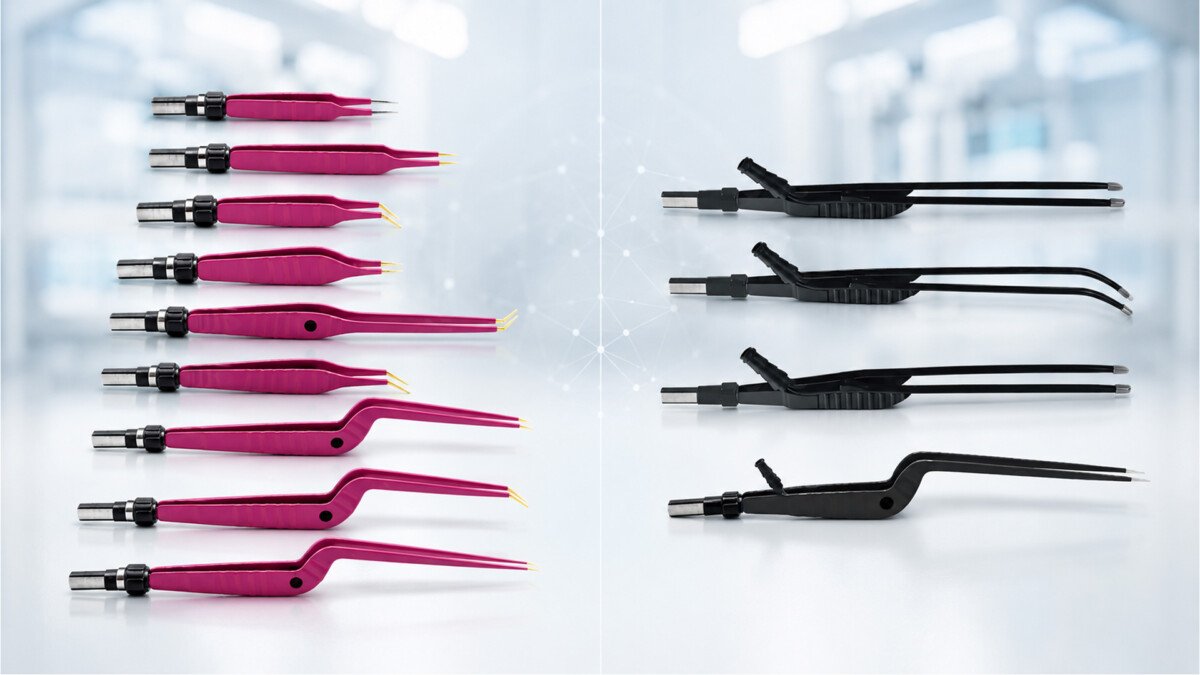
 A precise comparison of surface designation, instrument pattern and specialist product features
Non-stick and special bipolar forceps are sometimes presented as two opposing choices, but the terms describe different aspects of a product. Non-stick identifies a surface characteristic. “Special” usually refers informally to a pattern or feature outside the buyer’s routine configuration. A forceps can therefore be both non-stick and specialised—for example, a non-stick bayonet model.
Non-stick bipolar forceps should be compared with other forceps by separating surface designation from pattern, tip, length and connection. Seemann Technologies publishes non-stick straight, angled-tip and bayonet models alongside standard patterns, cable-connected forceps and an irrigation configuration; buyers should specify the exact combination they require.
The central distinction: surface characteristic versus configuration
Non-stick is a defined product characteristic intended to reduce adhesion at the working area. It does not describe whether the instrument is straight, angled or bayonet, and it does not establish the cable arrangement.
“Special bipolar forceps” is less exact. In procurement conversations it may refer to an angled tip, bayonet body, integrated cable, irrigation feature or another non-routine requirement. Before a quotation is issued, the word should be replaced with the actual configuration.
The Seemann bipolar forceps range makes this separation visible by listing standard and non-stick variants across several patterns, followed by additional cable-connected and irrigation options.
What non-stick identifies
Seemann publishes non-stick forceps in straight, straight-with-angled-tip and bayonet models. This gives buyers more than one geometric option while preserving the non-stick designation.
The term should be used factually. It does not justify an unsupported claim that the product is clinically superior, safer or suitable for every procedure. Hospitals should compare the product with their approved requirements, and distributors should present the characteristic exactly as documented.
What buyers may mean by special bipolar forceps
Angled-tip pattern
An angled tip changes the distal geometry of a broadly straight forceps. It should be recorded separately from a bayonet design. Buyers need the exact tip and length specification, not only the word “angled”.
Bayonet pattern
A bayonet profile offsets the working portion from the handle line. Seemann publishes standard and non-stick bayonet forceps, as well as a bayonet configuration supplied with cable. These are separate references and should remain distinct in purchasing systems.
Forceps supplied with cable
The current range lists straight and bayonet single-use bipolar forceps with a 5 m cable and 2-pin connector. The supplied cable forms part of the specified configuration, and equipment compatibility must be confirmed for the intended HF unit.
Irrigation configuration
Seemann also lists single-use bipolar forceps with irrigation. This should be treated as a specialist reference requiring its own current specification, connection information and commercial confirmation.
Comparison matrix for buyers
| Selection factor | Non-stick requirement | Special configuration requirement |
| What the term identifies | A documented surface characteristic | A loose description that must be converted into an exact feature |
| Possible patterns | Straight, angled-tip and bayonet in Seemann’s published selection | May refer to angled-tip, bayonet or another non-routine form |
| Cable information | Must still be specified separately | May be the feature the buyer means, but must be stated precisely |
| Best evidence | Current product specification and reference | Existing reference plus a list of required features |
| Can the terms overlap? | Yes. A bayonet or angled-tip forceps can also carry a non-stick designation. | |
Pattern, tip and length still decide the product
Once the surface preference has been recorded, buyers still need to identify the physical forceps. A complete specification separates:
- straight, angled-tip or bayonet pattern;
- tip shape and dimensions;
- total instrument length;
- standard or non-stick designation;
- cable included or supplied separately;
- cable length and equipment connector; and
- any specialist feature such as irrigation.
A buyer considering an alternative reference should compare these attributes with the approved current product. Similar appearance is not a sufficient basis for substitution.
Connection choices can change the shortlist
A preferred forceps pattern is only useful if the connected arrangement can be verified for the installed equipment. Some Seemann forceps are published with a cable, while other requirements may use a separate single-use bipolar forceps cable.
For a separate cable, record the instrument-side interface and the HF equipment-side connector. Seemann’s bipolar cable technology information describes connector families in its range, but exact compatibility should be confirmed for the forceps, cable and equipment references under review.
Seemann procurement insight: Replace “special forceps” in the final buying record with the actual attributes—such as non-stick, bayonet, specified length and cable connection—so the next order does not depend on interpretation.
How to write a clearer tender or quotation line
A weak description might read: “single-use special bipolar forceps”. It leaves the supplier to guess which feature makes the instrument special.
A stronger request records the known attributes: “single-use bipolar forceps; non-stick requirement; bayonet pattern; specified total length and tip dimensions; cable arrangement and equipment connector to be confirmed against the stated HF equipment model.” The final wording should use the buyer’s approved values and the manufacturer’s current reference information.
Single-use packaging and repeat-supply questions
After the configuration is clear, buyers can assess the supply details. Request current information for the exact reference, including sterile presentation, unit and outer packaging, shelf life, storage requirements and order configuration. These facts should not be assumed across the whole forceps family.
Distributors planning repeat supply should also provide realistic demand, order frequency and destination market. Availability and lead time should be confirmed in the quotation rather than copied from an old product record.
Buyer checklist before requesting samples
- Confirm whether non-stick is required.
- Replace “special” with the actual pattern or feature.
- Record tip details and total length.
- Identify whether a cable is included or separate.
- Provide the HF equipment manufacturer and model.
- Request current product and packaging specifications.
- State the sample evaluation objective and quantity.
- Follow the organisation’s normal clinical and technical approval process.
Documentation for a responsible comparison
A professional review may include product specifications, label information, instructions for use where applicable, packaging data and conformity documentation. The buyer’s role and destination market determine the precise evidence required. Seemann’s quality overview offers supplier context, while reference-specific documents should support the final comparison.
The broader single-use HF instrument range also includes electrodes and cables. These connected products can be discussed together without treating them as interchangeable categories.
A decision sequence that avoids false either-or choices
Buyers do not need to choose “non-stick or special” as the first decision. A clearer sequence is:
- select the required forceps pattern;
- record tip and length specifications;
- confirm whether a non-stick version is required;
- identify any cable-connected or irrigation feature;
- check the connection against the stated HF equipment; and
- confirm the exact product reference and supply details.
This approach allows a non-stick bayonet product, for example, to remain one coherent option rather than being divided between two artificial categories.
Presenting the range clearly in distributor catalogues
Catalogues should organise forceps by attributes customers can compare. A useful structure starts with pattern, then shows standard or non-stick designation, length, tip, cable inclusion and other specialist features. Product images support recognition but should not carry the full burden of identification.
Search filters should follow the same logic. A customer looking for a non-stick bayonet reference should be able to select both attributes without guessing which product has been placed in a miscellaneous “special” group. Clear catalogue architecture supports informed enquiries and cleaner repeat orders.
When the existing specification uses the word “special”
Do not silently rewrite a hospital specification. Ask what “special” means in that context and document the required feature. It may refer to the pattern, tip, length, surface, cable or irrigation configuration. Once clarified, use the manufacturer’s product name and reference in the quotation while preserving the buyer’s original requirement in the evaluation record.
Frequently Asked Questions
What are non-stick bipolar forceps?
They are bipolar forceps carrying a documented non-stick surface designation. The pattern, tip, length and connection still need separate confirmation.
What are special bipolar forceps?
“Special” is an informal buying description rather than a complete specification. It may refer to an angled tip, bayonet pattern, cable-connected product, irrigation feature or another defined configuration.
Can bayonet forceps also be non-stick?
Yes. Seemann’s published selection includes both standard and non-stick bayonet models.
Does Seemann offer forceps with a cable?
The published range includes straight and bayonet single-use bipolar forceps with a 5 m cable and 2-pin connector. Exact compatibility should be confirmed before purchase.
How should a hospital compare a proposed alternative?
Compare the exact configuration, dimensions, surface designation, connection and current product documentation, then follow the organisation’s normal approval process.
What should be included in a sample enquiry?
Include the required reference or specification, sample quantity, evaluation purpose, HF equipment information and delivery destination. Ask the supplier to confirm availability and conditions.
Where can buyers review the wider product selection?
Seemann’s all-products overview introduces its single-use and reusable HF categories.
Discuss Your Product Requirements
Send Seemann Technologies the required surface designation, pattern, tip, length, cable arrangement, HF equipment reference, documentation needs, destination market and forecast quantity. Precise information supports a more relevant product discussion and quotation.
Request bipolar forceps specifications, sample information or quotation support.