
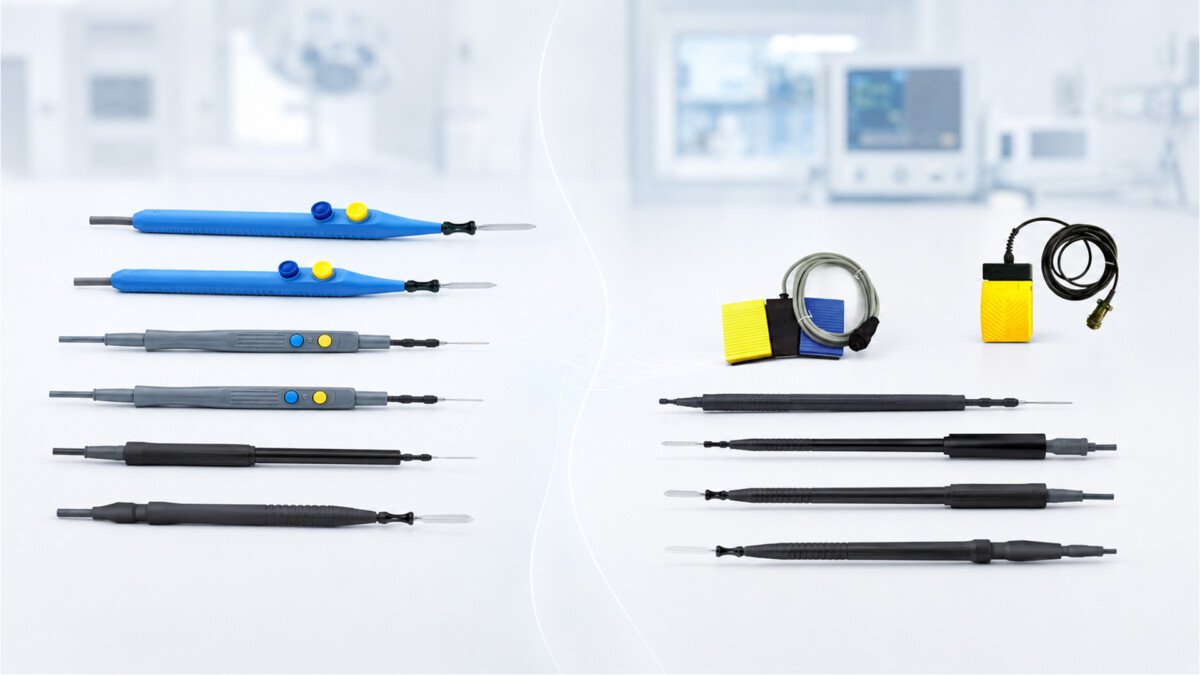
 Turn a familiar product name into an accurate HF handle, electrode and connection specification
Hand-control and foot-control cautery pencils are commonly compared as if the control choice were the entire specification. In practice, a professional enquiry also needs to identify the HF handle, electrode arrangement, cable length, connector and compatible electrosurgical equipment. Starting with the control method is useful; stopping there leaves too much open to interpretation.
Hand-control cautery pencils incorporate controls within the handle, while foot-control cautery pencils depend on a compatible external activation arrangement. Seemann Technologies publishes the broader product description “HF handles with cables and electrodes”; buyers should confirm whether a specific hand-control or foot-control reference is currently available before requesting samples or quotations.
Cautery pencil and HF handle: align the terminology first
Hospitals may use cautery pencil, electrosurgical pencil or diathermy pencil in their purchasing systems. Seemann’s verified single-use HF technology information uses HF handles with cables and electrodes. A good quotation can acknowledge the buyer’s familiar term while retaining the manufacturer’s exact product name.
This distinction is commercially important. It prevents a distributor from assigning a product description that implies a control arrangement or supply format not established by the current catalogue reference.
How the control arrangements differ
Hand-control configuration
A hand-control configuration uses controls associated with the handle. The buyer should identify the required control functions from the existing approved specification and confirm that the handle, cable and equipment interface support the intended arrangement.
The presence of buttons or switches should be established from product documentation rather than assumed from a generic image. The final product record should include the complete reference and current control description.
Foot-control configuration
A foot-control configuration relies on a documented external activation arrangement used with compatible HF equipment. The handle may therefore differ from a hand-control product even when the general shape appears similar.
Procurement teams should identify the installed equipment and control setup. The term “foot-control pencil” alone does not confirm which handle, electrode interface or equipment-side connector is required.
Comparison for procurement teams
| Selection point | Hand-control requirement | Foot-control requirement |
| Primary control | Control input associated with the handle | External control arrangement associated with compatible equipment |
| Key evidence | Handle specification, controls, cable and connector | Handle specification, equipment model and external control setup |
| Electrode selection | Confirm supplied or detachable electrode and handle interface | Confirm supplied or detachable electrode and handle interface |
| Compatibility check | Complete handle-to-equipment connection | Complete handle, equipment and control combination |
| Seemann availability | Confirm the current reference and product specification directly | |
Control method does not determine the electrode
After the control arrangement has been identified, the buyer must still specify the electrode. Important fields may include electrode form, shaft diameter, length and whether it is supplied with the handle or selected separately.
Seemann publishes a dedicated monopolar electrode range with short, long and specialised configurations. The existence of these product families does not establish compatibility with every HF handle. The electrode-to-handle interface should be confirmed for the exact references.
Supplied electrode or detachable electrode?
A handle supplied with an electrode creates a different item record from a handle intended for a detachable electrode. The distinction affects product identification, packaging and repeat ordering. A buyer should ask:
- Is an electrode included with the handle?
- If included, which electrode form and dimensions are supplied?
- If detachable, which shaft or interface is documented?
- Can other electrode forms be evaluated for that exact handle?
- Are the handle and electrode supplied under one or separate references?
The current product specification should answer these questions. “Standard electrode” is not precise enough for a quotation or compatibility decision.
Cable length and equipment-side connector
The cable connects the HF handle to the equipment interface. Record its numerical length, attachment to the handle and equipment-side connector. Similar-looking plugs can have different intended equipment matches, so photographs should support identification rather than replace documentation.
Provide the full HF equipment manufacturer and model. If a buyer is replacing an established pencil or handle, include the current product reference and images of any readable markings.
Seemann procurement insight: Describe the control arrangement, electrode interface, cable and equipment connector as four separate fields; this makes replacement and repeat-order checks much more reliable.
Why current product availability must be confirmed
Seemann’s public product information verifies the broader category of HF handles with cables and electrodes. The live information reviewed for this article does not establish exact hand-control and foot-control catalogue references. Professional content should therefore avoid assigning either control type to a Seemann product without current product evidence.
Buyers can still make a productive enquiry by supplying their required control arrangement, existing reference, electrode, cable and equipment details. Seemann can then confirm whether a relevant current product is available.
Buyer checklist before requesting a quotation
- State the familiar product term. Include cautery pencil, electrosurgical pencil or HF handle as used internally.
- Identify the control arrangement. Specify hand-control or foot-control based on the approved requirement.
- Describe the electrode. Include form, shaft and relevant length.
- Clarify the supply arrangement. State whether the electrode is included or detachable.
- Record the cable. Include cable length and attachment to the handle.
- Identify the connector and equipment. Provide the full HF equipment model and connector evidence.
- Request current documents. List the specifications and conformity evidence required.
- Add commercial information. Include destination, sample needs and forecast quantity.
Managing replacement enquiries
A replacement enquiry should begin with the current manufacturer and product reference. Record which attributes must match, including control method, electrode interface, cable length and connector. If the buyer requires a documented compatibility or equivalence assessment, state that requirement explicitly.
A visual match is not enough. The proposed product should be evaluated against current specifications and follow the organisation’s normal technical, procurement and clinical approval route.
Single-use and reusable considerations
The Seemann product overview separates single-use HF instruments from reusable HF categories. Buyers should establish the intended-use status of the exact handle and electrode rather than assuming that all products described by a familiar market term share the same supply format.
For single-use products, request current sterile status, packaging, shelf life and storage information. For reusable products, request the relevant manufacturer information concerning handling and reprocessing. Product content should never replace the instructions for use.
Documentation and catalogue records
Professional buyers may need product specifications, label information, instructions for use where applicable, packaging details and current conformity documentation. Seemann’s quality overview provides supplier background; reference-specific documents should support the final decision.
Distributors can preserve familiar customer language as a searchable synonym, but the official catalogue record should use the manufacturer’s complete product name. That practice supports natural search visibility without sacrificing technical accuracy.
What a useful quotation should confirm
A supplier quotation should name the proposed HF handle reference and state the verified control arrangement. It should also identify whether an electrode is included, the relevant electrode interface, cable length, connector and any equipment information used for the compatibility discussion.
If the requested hand-control or foot-control product is unavailable, an alternative should be described as a different configuration rather than silently substituted. The buyer can then decide whether the alternative should enter its normal evaluation process.
Planning a controlled sample evaluation
A sample request is most useful when it answers an unresolved purchasing question. The organisation might need to compare the documented control arrangement, confirm the physical connector or assess whether the supplied electrode matches the approved specification.
Send the sample request with the HF equipment model and current product reference. Retain the evaluated reference, accompanying documents and decision so that the eventual purchase order does not use a shortened or different description.
Keeping local terminology without losing accuracy
Belgian, Spanish, Irish and other European buyers may use different familiar terms for the same broad product area. A distributor can support those searches in its catalogue while maintaining one controlled manufacturer record behind them.
For example, cautery pencil, electrosurgical pencil and HF handle may lead a buyer to the same category. The final product comparison should still use Seemann’s current name, reference and verified configuration. This gives customers natural navigation without turning informal terminology into an unsupported product claim.
Frequently Asked Questions
What is the difference between hand-control and foot-control cautery pencils?
A hand-control configuration uses controls associated with the handle. A foot-control configuration depends on a compatible external activation arrangement.
Does Seemann Technologies call these products cautery pencils?
Seemann’s verified public information uses the description “HF handles with cables and electrodes”.
Does Seemann publish specific hand-control and foot-control references?
Exact references were not established in the live public information reviewed for this article. Buyers should request the current catalogue and specification before assigning either configuration to a Seemann product.
Can any monopolar electrode fit any HF handle?
No. The electrode interface, shaft requirements, handle specification and equipment connection should be confirmed for the exact combination.
What information is required for a compatibility check?
Provide the current handle reference, electrode details, cable length, connector images and complete HF equipment model.
Can buyers request samples?
Sample availability and conditions should be confirmed directly. Include the required configuration, evaluation purpose, quantity and destination.
Where can buyers discuss an HF handle requirement?
Hospitals and distributors can use the Seemann Technologies contact form to request current product information and quotation support.
Discuss Your Product Requirements
Send Seemann Technologies the required control arrangement, current pencil or handle reference, electrode details, cable length, connector information, HF equipment model, destination and expected volume. The team can then determine whether a relevant current configuration is available for discussion.
Discuss a hand-control or foot-control HF handle requirement.